

Last week, the US Senate confirmed Kevin Warsh as Chair of the Federal Reserve in a narrow 54–45 vote, the tightest confirmation margin for a Fed chair on record. Locally, the South African Reserve Bank (SARB) announced the appointment of Dr Konstantin Makrelov as the sixth member of its Monetary Policy Committee (MPC).
International Market Developments
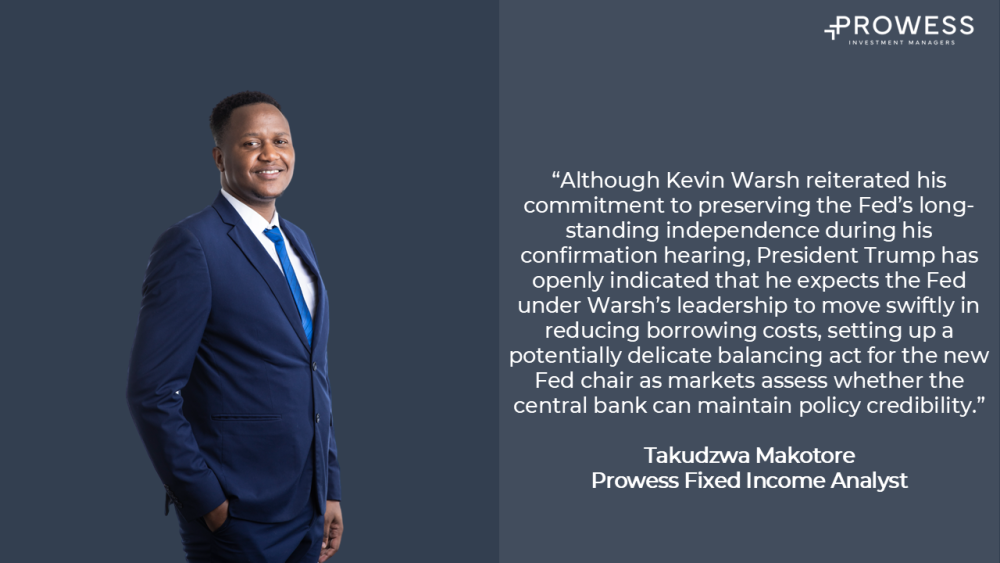
Last week, the US Senate confirmed Kevin Warsh as Chair of the Federal Reserve in a narrow 54–45 vote, the tightest confirmation margin for a Fed chair on record. During his confirmation process, Warsh reiterated his commitment to preserving the Fed’s long-standing independence, stressing that monetary policy decisions, particularly interest rate setting, would remain insulated from political pressure. Despite these assurances, Donald Trump has openly indicated that he expects the Fed under Warsh’s leadership to move swiftly in reducing borrowing costs. The dynamic sets up a potentially delicate balancing act for the new Fed chair as markets assess whether the central bank can maintain policy credibility while facing growing political pressure for monetary easing. Investors will closely monitor upcoming Fed communications for any shift in tone regarding the interest-rate outlook and the broader policy path.
US inflation accelerated in April, reinforcing concerns that price pressures remain persistent and that the Federal Reserve may keep interest rates higher for longer. Headline CPI increased to 3.8% year-on-year from 3.3% in March, exceeding market expectations and marking the fastest pace since May 2023. On a monthly basis, inflation rose 0.6%, driven mainly by higher energy prices, which increased 3.8% month-on-month and accounted for more than 40% of the overall rise in CPI. Shelter and food prices also remained elevated, increasing 0.6% and 0.5% respectively. Core CPI, which excludes food and energy, rose to 2.8% year-on-year from 2.6%, indicating that underlying inflation pressures remain broad-based, particularly across services categories. Minneapolis Fed President Neel Kashkari reiterated that the Fed remains committed to returning inflation to its 2% target. He noted that the labour market remains resilient and warned that the Iran conflict and higher energy prices have significantly increased inflation uncertainty and upside risks.
Looking ahead, FOMC meeting minutes from the April meeting are expected to be released on Wednesday.
Local Market Developments
Last week, the South African Reserve Bank (SARB) announced the appointment of Dr Konstantin Makrelov as the sixth member of its Monetary Policy Committee (MPC). He will assume the roles of Chief Economist and Head of Economic Research, while also joining the MPC and Financial Stability Committee. Makrelov succeeds Christopher Loewald, who retired earlier this year. The SARB emphasised Makrelov’s extensive institutional experience, noting that he joined the central bank in 2018 and has been instrumental in shaping its macroeconomic, climate-related and broader policy research agenda. SARB also highlighted his international policy engagement, particularly his involvement in the G20 Sustainable Finance Working Group. His appointment is viewed as supportive of policy continuity at the SARB, given his long-standing involvement in the institution’s research and monetary policy framework.
According to the Quarterly Labour Force Survey (QLFS), South Africa’s unemployment rate deteriorated in Q1:26, rising to 32.7% from 31.4% in Q4:25. The number of unemployed individuals increased by 301,000 quarter-on-quarter to 8.137 million, while total employment declined by 345,000 to 16.754 million, highlighting continued weakness in the domestic labour market. The bulk of job losses were concentrated in labour-intensive sectors, particularly community and social services (-206,000) and construction (-110,000), suggesting ongoing pressure on public sector-related activity and infrastructure investment. Additional employment declines were recorded in private households, finance, utilities and trade. In contrast, some cyclical sectors showed resilience, with manufacturing (+38,000), mining (+32,000) and agriculture (+10,000) posting modest employment gains. However, these increases were insufficient to offset broader labour market weakness.
Looking ahead, April CPI numbers are due on Wednesday. CPI is expected at 3.9% year-on-year from 3.1% in March.