


Blue Wave, Narrow Opening
Senior Fixed Income Portfolio Manager Jacques Simpson explores what the United States midterm results mean for Donald Trump’s final two years, and for South Africa…
Senior Fixed Income Portfolio Manager Jacques Simpson explores what the United States midterm results mean for Donald Trump’s final two years, and for South Africa…

Last week, the US Federal Reserve maintained its benchmark Fed funds rate unchanged at 3.75%–4.00%, while this week both the US and South Africa head to the polls…

South Africa is climbing the ratings ladder for the first time in two decades. S&P upgraded the sovereign in November 2025, Moody’s moved its outlook to positive in May 2026 — its first positive outlook since 2007 — and Fitch delivered its first upgrade in almost 21 years in June 2026 [1][2][6][8]. All three major agencies now place the country at BB/Ba2, two notches below investment grade, and the positive outlooks at S&P and Moody’s signal, in Treasury’s reading, possible upgrades within 12–18 months [7]. The October 2026 Medium-Term Budget Policy Statement (MTBPS) and S&P’s scheduled 27 November review make this a decisive moment [15].

The FOMC held the federal funds target range at 3.75–4.00% on 28 October in a 10–2 vote, with Governor Lisa Cook and Cleveland Fed President Beth Hammack dissenting in favour of an immediate hike [2][4]. Futures price roughly an 85% chance of a 25bp hike at the 8–9 December meeting [2], and every economist in Reuters’ October poll expects one [5]. Because Chair Kevin Warsh rejects forward guidance outside a crisis and does not submit a dot [2][3], incoming data, not Fed signalling, will decide three things over the next three months: whether December’s hike happens, whether January brings another, and what the December dot plot says about 2027. Inflation prints matter most, with 0.3% versus 0.2% on monthly core inflation as the dividing line; the unemployment rate relative to the Fed’s 4.1% projection is the main counterweight.

Last week, the US federal government recorded a budget deficit of $26.9 billion for September, bringing the total for fiscal year 2026 to $1.992 trillion, or 6.2% of GDP. Locally, South Africa’s Finance Minister Enoch Godongwana tabled the Medium-Term Budget Policy Statement (MTBPS) which was well received by the market.

Are you concerned that you may be losing focus? Are you overwhelmed with the demands of balancing work, personal responsibilities, and everything else? Are you wondering whether you are still on the right path and on track to meet your career and life goals?

Finance Minister Enoch Godongwana delivered South Africa’s 2026 Medium-Term Budget Policy Statement (MTBPS) on 21 October. National Treasury (NT) emphasised reducing the debt ratio, improving spending quality and efficiency, and directing more resources to infrastructure and growth-enhancing reforms.

Globally, US inflation continues to print higher, while locally the IMF has cut South Africa’s 2026 growth forecast to 1.0% from 1.1%.
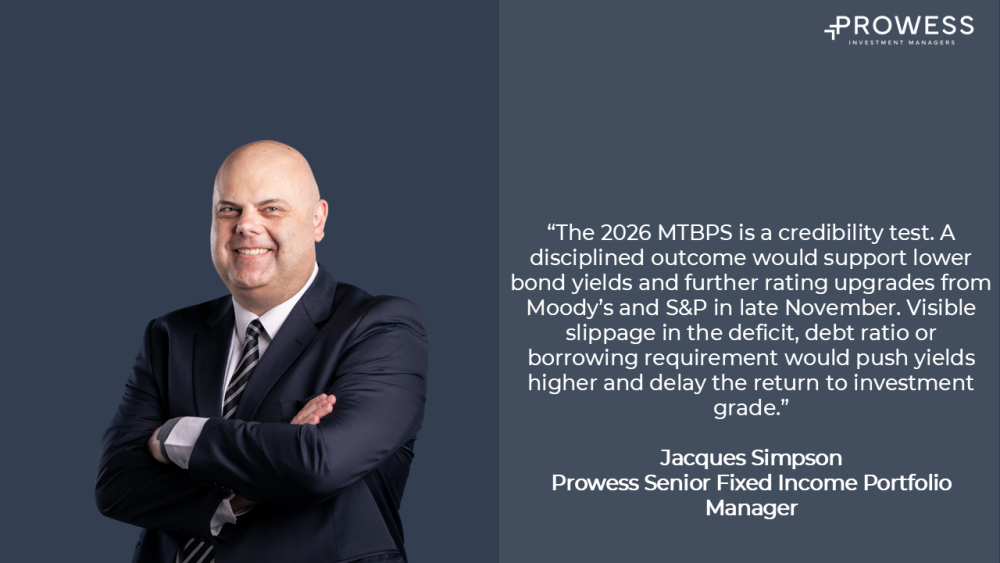
Finance Minister Enoch Godongwana will table the 2026 Medium-Term Budget Policy Statement (MTBPS) in Parliament on 21 October 2026. The MTBPS does not normally contain tax changes; instead, it revises the economic outlook and fiscal framework and sets the direction for the February 2027 Budget.
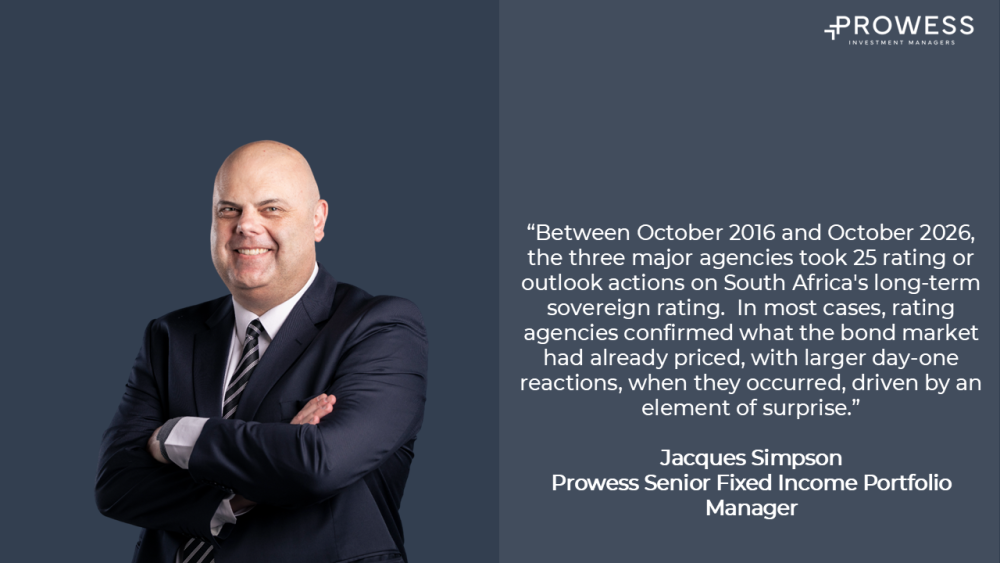
Between October 2016 and October 2026, the three major agencies took 25 rating or outlook actions on South Africa’s long-term sovereign rating, grouped here into 23 market events. A usable bond-market reaction (basis-point move in the benchmark rand government bond) was found in contemporaneous market reports for 14 of them.