


1. Executive summary
Between October 2016 and October 2026, the three major agencies took 25 rating or outlook actions on South Africa’s long-term sovereign rating, grouped here into 23 market events. A usable bond-market reaction (basis-point move in the benchmark rand government bond) was found in contemporaneous market reports for 14 of them. The main findings:
- The headline action is a poor predictor of the bond move. Correlating a simple credit-action score (one notch = 1, one outlook step = 0.5) with the yield change gives r = -0.20 across the 14 events: the right sign, but weak and not statistically significant.
- What moves yields is the outcome relative to expectations. Classifying each event as better or worse than markets feared (from the reports cited) lifts the correlation to r = -0.59, and to r = -0.86 once the single day dominated by a global stimulus rally (30 April 2020) is set aside.
- Rating downgrades produced the largest moves, but not consistently in one direction. Six downgrades with data averaged +0.2bp but an absolute move of 12.5bp. Yields rose on four (up to +16bp on S&P’s April 2017 junk call) and fell on two where other news dominated.
- Negative outlook changes were the most two-sided. Four events averaged -3.9bp but 14.4bp in absolute terms: +18bp on Fitch’s July 2019 cut, yet -15.5bp and -21bp when a negative outlook arrived alongside relief that a downgrade had been avoided.
- Positive actions were small but perfectly consistent. All four credit-positive events with data (three positive outlook revisions and the November 2025 S&P upgrade) saw yields fall, by 5-7.5bp, averaging -5.75bp. These were largely anticipated after budget news, so the market had already moved.
- Crossing the investment-grade line mattered most. The three junk calls that were not offset by a reprieve elsewhere (S&P Apr 2017, Fitch Apr 2017, Moody’s Mar 2020) moved yields up 6.5-16bp, reflecting forced index selling, not just a change in perceived default risk.
Bottom line: for South Africa, rating agencies have mostly confirmed what the bond market had already priced. The day-one reaction is driven by surprise and by index mechanics, and the larger repricing tends to occur before the announcement (around budgets, political shocks and agency commentary).
2. Scope and method
- Universe: every revision to the rating, outlook or review status of South Africa’s long-term sovereign rating by S&P, Moody’s and Fitch from October 2016 to 16 October 2026. Affirmations with no change are excluded. Scope Ratings and others are excluded.
- Reaction window: the first trading session after the announcement. Agencies usually publish after the JSE closes on a Friday, so the reaction is normally Monday’s move.
- Yield measure: the basis-point change in the benchmark rand government bond as reported by Reuters, Bloomberg and the SA financial press (R186 until about 2020, then R2030 and R2035 as the benchmark rolled). Where no figure was published the event is listed but excluded from statistics.
- Classification: actions are split into rating downgrades, rating upgrades, negative outlook/review actions and positive outlook actions. Each event also carries a credit-action score and a ‘news vs expectations’ flag (+1 if the reports describe the outcome as better than feared, otherwise the sign of the action).
- Statistics: mean and mean-absolute move by category, hit rate (share of events where yields moved in the direction the action implies) and Pearson correlations. All are calculated with live formulas.
3. The ratings path, 2016-2026
The decade divides into three phases. From late 2016 to 2020, South Africa slid from investment grade to sub-investment grade at all three agencies: S&P and Fitch moved it to junk in April 2017 after the dismissal of the finance minister, and Moody’s followed in March 2020 as COVID-19 hit, ejecting rand bonds from the FTSE World Government Bond Index. A further round of cuts in April and November 2020 left the sovereign at BB- (S&P, Fitch) and Ba2 (Moody’s).
From late 2021 to 2024 the trend stabilised. Fitch (December 2021) and Moody’s (April 2022) moved outlooks to stable on a commodity-led revenue windfall; S&P went positive in May 2022, withdrew it in March 2023 because of load-shedding, and restored it in November 2024 after the formation of the Government of National Unity.
Since late 2025 the cycle has turned up. S&P upgraded South Africa in November 2025, its first upgrade in about two decades; Moody’s moved to a positive outlook in May 2026, its first since 2007; and Fitch upgraded to BB in June 2026. As of mid-October 2026, Moody’s has signalled that an upgrade is possible if fiscal performance keeps improving.
|
Agency |
Foreign-currency rating |
Outlook |
Last change |
|
S&P Global |
BB (local currency BB+) |
Positive |
Upgrade, 14 Nov 2025 |
|
Moody’s |
Ba2 |
Positive |
Outlook to positive, 22 May 2026 |
|
Fitch |
BB |
Stable |
Upgrade, 5 Jun 2026 |
Table 1. Current sovereign ratings, October 2026
4. Event table, October 2016 – October 2026
Yield change is the reported move in the benchmark rand bond on the first session after the announcement (n/r = not reported). The full table, with expectation flags, confounding factors, timing of each print, rand moves and sources, is in the companion workbook.
|
# |
Announced |
Agency |
Category |
From |
To |
Bond |
Yield chg (bp) |
Context |
|
1 |
25 Nov 2016 |
Fitch (Moody’s affirmed same night) |
Outlook negative |
BBB- / Stable |
BBB- / Negative |
R186 (2026) |
-21.0 |
Moody’s affirmed Baa2 the same evening; relief at investment grade being kept plus a weaker USD dominated. |
|
2 |
02 Dec 2016 |
S&P |
Rating downgrade |
LC BBB+ (FC BBB- Neg) |
LC BBB (FC BBB- Neg) |
– |
n/r |
Local-currency cut widely expected; FC kept at investment grade. Bonds reported stronger but no bp figure published. |
|
3 |
03 Apr 2017 |
S&P (+ Moody’s review for downgrade) |
Rating downgrade |
FC BBB- / LC BBB |
FC BB+ / LC BBB- / Negative |
R186 (2026) |
+16.0 |
First junk rating since 2000, days after Finance Minister Gordhan was fired. Moody’s put Baa2 on review the same night. |
|
4 |
07 Apr 2017 |
Fitch |
Rating downgrade |
BBB- / Negative |
BB+ / Stable |
R186 (2026) |
+6.5 |
Second agency to junk in one week; triggered exit from investment-grade-only indices. |
|
5 |
09 Jun 2017 |
Moody’s |
Rating downgrade |
Baa2 / Review |
Baa3 / Negative |
– |
n/r |
Kept at investment grade; reports describe a composed, largely priced-in reaction. No bp figure published. |
|
6 |
24 Nov 2017 |
S&P (+ Moody’s review for downgrade) |
Rating downgrade |
FC BB+ / LC BBB- |
FC BB / LC BB+ / Stable |
R186 (2026) |
-12.0 |
S&P pushed local-currency debt to junk, but Moody’s only placed Baa3 on review, keeping SA in the WGBI. Relief dominated. |
|
7 |
23 Mar 2018 |
Moody’s |
Outlook positive |
Baa3 / Review for downgrade |
Baa3 / Stable |
R186 (2026) |
-7.5 |
Affirmation expected, but the move to a stable outlook surprised; strongest bond prices since early 2015. |
|
8 |
26 Jul 2019 |
Fitch |
Outlook negative |
BB+ / Stable |
BB+ / Negative |
10-year benchmark |
+18.0 |
Same-day move also reflects Moody’s ‘credit negative’ Eskom comment the day before; R186 was flat the following Monday. |
|
9 |
01 Nov 2019 |
Moody’s |
Outlook negative |
Baa3 / Stable |
Baa3 / Negative |
R186 (2026) |
-15.5 |
Best-case outcome versus feared downgrade or review; bonds had their best day since early 2018. |
|
10 |
22 Nov 2019 |
S&P |
Outlook negative |
BB / Stable |
BB / Negative |
– |
n/r |
No bp figure found in contemporaneous reports. |
|
11 |
27 Mar 2020 |
Moody’s |
Rating downgrade |
Baa3 / Negative |
Ba1 / Negative |
R186 (2026) |
+12.5 |
Lost last investment-grade rating -> WGBI exit. Coincided with COVID lockdown; SARB bond buying cushioned the move. |
|
12 |
03 Apr 2020 |
Fitch |
Rating downgrade |
BB+ / Negative |
BB / Negative |
Benchmark |
+3.0 |
Peak COVID stress; yields had already jumped 35bp on the Friday before the announcement. |
|
13 |
29 Apr 2020 |
S&P |
Rating downgrade |
FC BB / LC BB+ |
FC BB- / LC BB / Stable |
R186 (2026) |
-25.0 |
Global stimulus rally overwhelmed the downgrade, even on the day of the WGBI exit. |
|
14 |
20 Nov 2020 |
Moody’s |
Rating downgrade |
Ba1 / Negative |
Ba2 / Negative |
– |
n/r |
Announced the same night as Fitch (row 15); rand regained Friday’s losses. No bp figure found. |
|
15 |
20 Nov 2020 |
Fitch |
Rating downgrade |
BB / Negative |
BB- / Negative |
– |
n/r |
See row 14. |
|
16 |
16 Dec 2021 |
Fitch |
Outlook positive |
BB- / Negative |
BB- / Stable |
– |
n/r |
Described as unexpected. Announced on a SA public holiday; no bp figure found. |
|
17 |
01 Apr 2022 |
Moody’s |
Outlook positive |
Ba2 / Negative |
Ba2 / Stable |
– |
n/r |
No bp figure found; followed by a 2.3x oversubscribed $3bn Eurobond issue. |
|
18 |
20 May 2022 |
S&P |
Outlook positive |
BB- / Stable |
BB- / Positive |
R2030 |
-5.0 |
Followed a 50bp SARB hike the prior Thursday. |
|
19 |
08 Mar 2023 |
S&P |
Outlook negative |
BB- / Positive |
BB- / Stable |
R2030 |
+3.0 |
Off-calendar removal of the positive outlook (load-shedding). Rand firmed on a weaker USD. |
|
20 |
15 Nov 2024 |
S&P |
Outlook positive |
BB- / Stable |
BB- / Positive |
R2030 |
-5.5 |
SARB rate cut expected that week; first positive outlook under the GNU. |
|
21 |
14 Nov 2025 |
S&P |
Rating upgrade |
FC BB- / LC BB / Positive |
FC BB / LC BB+ / Positive |
R2035 |
-5.0 |
First upgrade since 2005; yields hit a record low, but the MTBPS and 3% inflation target had done most of the work. |
|
22 |
22 May 2026 |
Moody’s |
Outlook positive |
Ba2 / Stable |
Ba2 / Positive |
– |
n/r |
First Moody’s positive outlook since 2007. No bp figure found; Iran-war oil shock dominated markets. |
|
23 |
05 Jun 2026 |
Fitch |
Rating upgrade |
BB- / Stable |
BB / Stable |
– |
n/r |
First Fitch upgrade in ~21 years. No bp figure found; Middle East escalation reversed rand gains. |
Table 2. Rating-agency actions on South Africa and the reported bond-yield reaction
5. Impact analysis
5.1 Average reaction by type of action
|
Group |
Actions |
With data |
Mean (bp) |
Mean |move| (bp) |
Range (bp) |
Hit rate |
|
Rating downgrades |
10 |
6 |
+0.2 |
12.5 |
-25.0 to +16.0 |
67% |
|
Rating upgrades |
2 |
1 |
-5.0 |
5.0 |
-5.0 |
100% |
|
Negative outlook / review |
5 |
4 |
-3.9 |
14.4 |
-21.0 to +18.0 |
50% |
|
Positive outlook |
6 |
3 |
-6.0 |
6.0 |
-7.5 to -5.0 |
100% |
|
All rating revisions |
12 |
7 |
-0.6 |
11.4 |
-25.0 to +16.0 |
71% |
|
All outlook revisions |
11 |
7 |
-4.8 |
10.8 |
-21.0 to +18.0 |
71% |
|
All credit-positive |
8 |
4 |
-5.75 |
5.75 |
-7.5 to -5.0 |
100% |
|
All credit-negative |
15 |
10 |
-1.45 |
13.25 |
-25.0 to +18.0 |
60% |
|
Investment-grade line crossed |
4 |
4 |
+5.75 |
11.75 |
-12.0 to +16.0 |
75% |
Table 3. Yield reaction by category. Hit rate = share of events in which yields moved in the direction the action implies.
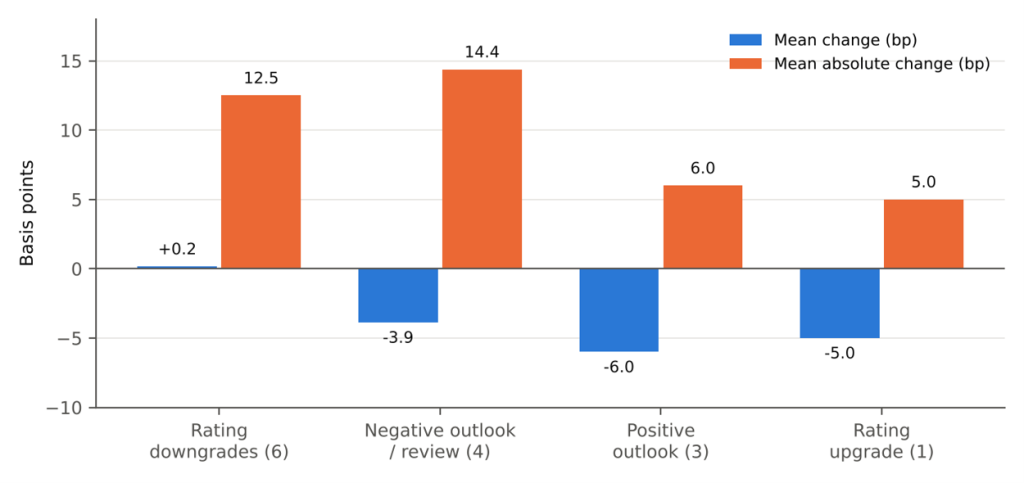
Figure 1. Mean and mean-absolute yield change by category (number of events with data in brackets)
5.2 Outlook revisions versus rating revisions
Rating revisions are the bigger events in absolute terms (mean absolute move 11.4bp) and, when they cross the investment-grade boundary, they carry mechanical consequences: removal from investment-grade-only indices such as the JPMorgan EMBIG (April 2017) and the FTSE WGBI (after Moody’s in March 2020). Even so, the average signed move on downgrades is close to zero, because two downgrades coincided with dominant offsetting news: Moody’s holding its investment-grade rating on the same night as S&P’s November 2017 cut, and a global stimulus rally on 30 April 2020.
Negative outlook revisions are the most two-sided. When a negative outlook was the feared outcome, yields rose (Fitch, July 2019: +18bp). When the market had braced for a downgrade or review and got ‘only’ a negative outlook, bonds rallied hard (Moody’s, November 2019: -15.5bp, the best day for bonds since early 2018; Fitch and Moody’s, November 2016: -21bp). An outlook action is therefore read as information about the probability of the next rating move, measured against what was already priced.
Positive outlook revisions and upgrades have been modest and one-directional. Yields fell in every case with data, by 5-7.5bp, and the market generally treated them as confirmation of an improving fiscal story already reflected in prices. The S&P upgrade of November 2025 pushed the 2035 bond to a record-low yield, but the move on the day was only 5bp because the budget update and the new 3% inflation target had driven most of the rally beforehand.
In short: outlook improvements have a smaller but more reliable effect (100% hit rate, about -6bp), while rating changes have a larger but noisier effect that depends heavily on whether they were expected and whether they trigger index changes.
5.3 Correlation of events with the size of the yield reaction
|
Measure |
Pearson r |
Points |
Interpretation |
|
Headline credit-action score vs yield change |
-0.20 |
14 |
Weak; not significant (p ~ 0.50) |
|
Rating revisions only |
-0.15 |
7 |
Weak |
|
Outlook revisions only |
-0.10 |
7 |
Weak |
|
News vs expectations vs yield change |
-0.59 |
14 |
Moderate-strong (p ~ 0.03) |
|
News vs expectations, excl. 30 Apr 2020 |
-0.86 |
13 |
Strong (p < 0.001) |
Table 4. Correlations between event characteristics and the yield change (negative r = credit-positive news lowers yields)
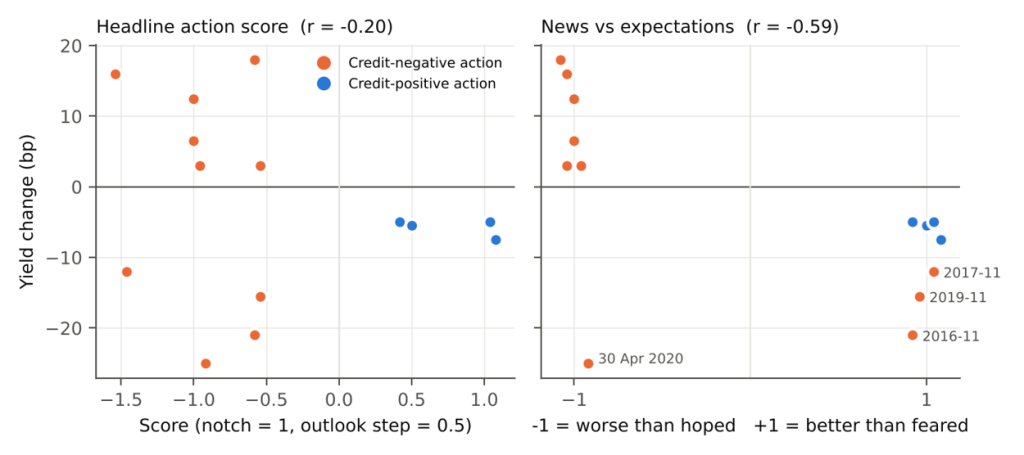
Figure 2. Yield change against the headline action score (left) and against news relative to expectations (right)
The left panel shows why the headline action is a poor guide: credit-negative actions (orange) are scattered above and below zero. Re-sorting the same events by whether the outcome beat or missed expectations (right panel) separates them cleanly; the three relief events of November 2016, November 2017 and November 2019 move across to the ‘better than feared’ side, where they belong economically. The remaining outlier, 30 April 2020, is a global risk-on day that overwhelmed an S&P downgrade.
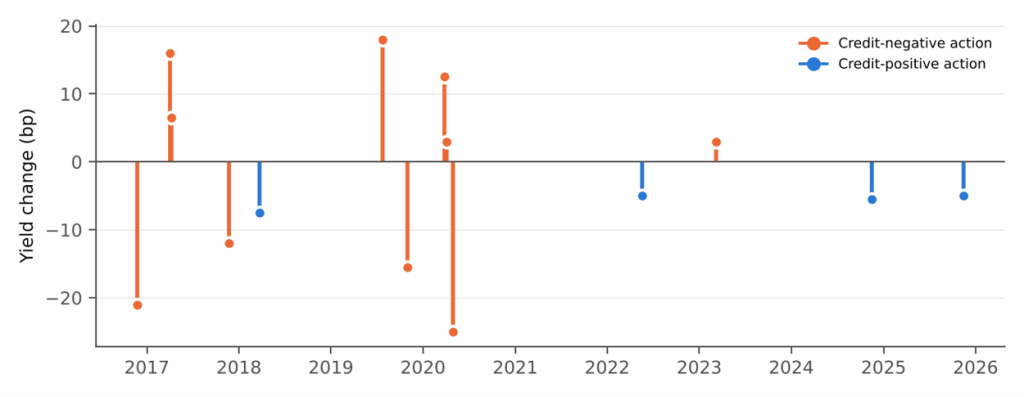
Figure 3. Reported yield reaction to each event with data, 2016-2026
6. Key episodes
April 2017 – the political junk call. S&P’s cut to BB+ came days after President Zuma replaced Finance Minister Gordhan, with Moody’s placing its rating on review the same night. The 2026 bond rose 16bp the next day and Fitch’s cut four days later added 6.5bp more, with dollar bonds pushed out of JPMorgan’s investment-grade index. Much of the damage was already done in the preceding week as the reshuffle unfolded.
November 2017 and November 2019 – Moody’s reprieves. In both cases Moody’s was the last agency holding South Africa at investment grade. Avoiding a cut (a review in 2017, a negative outlook in 2019) kept rand bonds in the WGBI, and yields fell 12bp and 15.5bp despite formally negative actions.
March-April 2020 – junk across the board amid COVID-19. Moody’s downgrade added 12.5bp at Monday’s open, but this was small against the March sell-off that had already pushed 10-year yields above 12%, and the SARB’s bond-buying programme limited the spike. Fitch’s follow-up cut added only 3bp.
2025-2026 – the upgrade cycle. S&P’s November 2025 upgrade, Moody’s May 2026 positive outlook and Fitch’s June 2026 upgrade each landed into a market that had already rallied on fiscal consolidation, the exit from the FATF grey list and the lower inflation target. Day-one moves were small (-5bp on the S&P upgrade). The Moody’s and Fitch actions also coincided with the oil shock from the Middle East conflict, which dominated rand and bond direction.
7. Implications
- For forecasting, the useful question is not ‘will the agency act?’ but ‘how does the likely action compare with what is priced?’ Market surveys, positioning and agency commentary between reviews matter more than the decision itself.
- Index thresholds create asymmetry. The largest single-day moves came when an action crossed the investment-grade line and triggered forced selling. A future return to investment grade (two notches away at all three agencies) could work in reverse and is likely to have a larger effect than the within-junk upgrades seen so far, although much would again be priced in advance.
- Positive outlooks from Moody’s and S&P are currently open, so the next upgrades are widely anticipated. On this history, a delivered upgrade would probably move yields only a few basis points on the day; a surprise removal of a positive outlook would be the higher-impact scenario, as in March 2023 when S&P’s withdrawal coincided with a three-year low in the rand.
8. Limitations
- Yield moves come from press reports, not a uniform close-to-close data series. Some are morning prints, others close, and the benchmark bond changes over the period.
- Nine of 23 events have no published basis-point figure; most of these are credit-positive or 2020-2026 events, which limits the evidence on recent outlook improvements.
- Sample size is small (14 usable points). Correlations are descriptive, and the expectations flag is a judgement based on contemporaneous reporting.
- Many events overlap with other drivers (COVID-19, budgets, SARB decisions, global risk swings).
Sources
- Business Report/Reuters, ‘Rand firms after decisions by Fitch and Moody’s’, 28 Nov 2016. https://m.motoring.co.za/business-report/markets/rand-firms-after-decisions-by-fitch-and-moodys-2093951
- BusinessLive, ‘Market wrap: Monday, December 5’, 2016; SAnews, 3 Dec 2016. https://www.businesslive.co.za/bd/markets/2016-12-05-market-wrap-monday-december-5/
- Reuters via Business Standard, ‘South African markets fall sharply after S&P downgrade’, 4 Apr 2017. https://www.business-standard.com/amp/article/reuters/south-african-markets-fall-sharply-after-s-p-downgrade-117040400578_1.html
- Business Report/Reuters, ‘Rand falls as politics, downgrades weigh’, 10 Apr 2017; Fin24, 7 Apr 2017. https://m.motoring.co.za/business-report/markets/rand-falls-as-politics-downgrades-weigh-8577353
- Sowetan Live, ‘Rand holds up after Moody’s downgrade’, 12 Jun 2017. https://www.sowetanlive.co.za/business/2017-06-12-rand-holds-up-after-moodys-downgrade/
- Bloomberg via BusinessTech, ‘Rand surges 3% as traders cheer respite from Moody’s’, 28 Nov 2017; Reuters/YJC 27 Nov 2017. https://businesstech.co.za/news/banking/213369/rand-surges-3-as-traders-cheer-respite-from-moodys/
- Business Report, ‘Rand hits 1-month high on Moody’s move’, 27 Mar 2018. https://m.tonight.co.za/business-report/markets/rand-hits-1-month-high-on-moodys-move-14104274
- Reuters via Business Recorder, ‘Rand, bonds tumble as Moody’s and Fitch warn of Eskom risk’, 26 Jul 2019. https://www.brecorder.com/news/amp/513195
- Reuters via IOL Business Report, 4 Nov 2019; Bloomberg via Fin24, 4 Nov 2019. https://iol.co.za/business-report/economy/2019-11-04-south-african-markets-get-short-term-boost-from-moodys-reprieve/
- BusinessTech, ‘South Africa outlook cut to negative by S&P’, 23 Nov 2019. https://businesstech.co.za/news/banking/356551/south-africa-outlook-cut-to-negative-by-sp/
- Reuters via Yahoo, ‘South Africa’s rand crashes to all-time low after Moody’s pulls the plug’, 30 Mar 2020. https://sg.news.yahoo.com/south-africas-rand-crashes-time-133440324.html
- Reuters via Business Report, ‘SA rand weakens after another Fitch downgrade’, 6 Apr 2020. https://businessreport.co.za/economy/2020-04-06-sa-rand-weakens-after-another-fitch-downgrade
- Bloomberg via BusinessTech, ‘Rand extends gains for a fifth straight day’, 30 Apr 2020. https://businesstech.co.za/news/finance/394244/rand-extends-gains-for-a-fifth-straight-day/
- BusinessLive, ‘Rand steadies after ratings downgrades for SA’, 23 Nov 2020. https://www.businesslive.co.za/bd/markets/2020-11-23-rand-lifts-despite-sas-ratings-downgrades/
- Bloomberg via BusinessTech, ‘Fitch upgrades South Africa outlook to stable’, 16 Dec 2021; National Treasury statement. https://businesstech.co.za/news/finance/547526/fitch-upgrades-south-africa-outlook-to-stable/
- Bloomberg via BusinessTech, 2 Apr 2022; RMB media release, 12 Apr 2022. https://businesstech.co.za/news/business/573698/south-africas-credit-outlook-upgraded-by-moodys/
- Reuters via Engineering News, ‘Rand supported by S&P outlook upgrade’, 23 May 2022. https://www.engineeringnews.co.za/article/rand-supported-by-sp-outlook-upgrade-2022-05-23
- Reuters via Kitco, ‘South African rand firms after recovering 3-year low’, 9 Mar 2023. https://www.kitco.com/news/off-the-wire/2023-03-09/update-1-south-african-rand-firms-after-recovering-3-year-low
- Reuters via Engineering News / CNBC Africa, ‘South African rand firms on S&P outlook upgrade’, 18 Nov 2024. https://www.engineeringnews.co.za/article/south-african-rand-firms-on-sp-outlook-upgrade-2024-11-18
- Bloomberg via Polity/News24, ‘SA bond yields fall to record low after ratings upgrade’, 17 Nov 2025; Reuters 17 Nov 2025. https://polity.org.za/article/south-african-yields-fall-to-record-low-after-sp-rating-upgrade-2025-11-17
- Moody’s rating action (via National Treasury), 22 May 2026; SAnews, 25 May 2026. https://www.sanews.gov.za/south-africa/moodys-revises-south-africas-outlook-positive
- Investec, ‘Rand note: rand gains on Fitch upgrade’, Jun 2026; Momentum Investments note, Jun 2026. https://www.investec.com/en_za/focus/economy/rand-note.html
- South African Reserve Bank, ‘South Africa’s long-term sovereign credit ratings history’, Quarterly Bulletin box, June 2017. https://www.resbank.co.za/content/dam/sarb/publications/quarterly-bulletins/boxes/2017/7869/20170630South-Africa-s-long-term-sovereign-credit-ratings-history.pdf
- Fin24, ‘Timeline: SA’s credit rating journey since 1994’, 24 Nov 2019. https://www.news24.com/fin24/Opinion/timeline-sas-credit-rating-journey-since-1994-20191124
- FX Empire, ‘South Africa credit ratings & outlooks’. https://fxempire.com/credit-ratings/south-africa
- Reuters via Business Recorder, ‘Rand steadies…’ (R186 flat, 29 Jul 2019). https://www.brecorder.com/news/513489
- Bloomberg via Fin24, ‘Rand rallies with bonds as SA dodges Moody’s downgrade’, 4 Nov 2019. https://www.fin24.com/Markets/Currencies/rand-rallies-with-bonds-as-sa-dodges-moodys-downgrade-20191104
- Reuters via YJC, ‘South African government bonds weaker after S&P downgrade’, 27 Nov 2017. https://www.yjc.ir/en/news/16207/south-african-government-bonds-weaker-after-s&p-downgrade
- Fin24, ‘Rand, bonds fall as junk rating triggers index exit’, 7 Apr 2017. https://www.fin24.com/Markets/Equities/rand-bonds-fall-as-junk-rating-triggers-index-exit-20170407
- National Treasury, Government’s response to S&P rating action, 9 Mar 2023. https://www.treasury.gov.za/comm_media/press/2023/2023030901 Media statement – Government’s response to S&P Global Ratings.pdf
- Investec, Tertia Jacobs, ‘S&P adjusts sovereign rating outlook’, Mar 2023. https://www.investec.com/en_za/beyond-the-headlines/tertia-jacobs/s-and-p-adjusts-sovereign-rating-outlook.html
- National Treasury, Government’s response to Fitch rating action, 16 Dec 2021. https://www.treasury.gov.za/comm_media/press/2021/2021121601 Media Statement – Government Response to Fitch’s Rating Action.pdf
- National Treasury, Fitch media statement, 3 Apr 2020. https://www.treasury.gov.za/comm_media/press/2020/20200403 Media Statement – Fitch.pdf
- Moody’s Ratings, rating action on South Africa (via National Treasury), 22 May 2026. https://www.treasury.gov.za/comm_media/press/2026/Rating Action Moodys Ratings changes South 22 May 2026.pdf
- Business Day/Reuters, ‘Fitch upgrades South Africa’s credit rating on lower debt projections’, 5 Jun 2026. https://www.businessday.co.za/economy/2026-06-05-fitch-upgrades-south-africas-credit-rating-on-lower-debt-projections/
- Daily Maverick, ‘Fitch lifts SA’s credit rating, citing prudent fiscal management’, 7 Jun 2026. https://www.dailymaverick.co.za/article/2026-06-07-fitch-lifts-sas-credit-rating-citing-prudent-fiscal-management/
- Momentum Investments, ‘Fitch upgraded SA’s sovereign rating’, Jun 2026. https://sls-fresco.momentum.co.za/files/documents/corporate/mim/updates-and-news/fitch-upgraded-sa-s-sovereign-rating-june-2026.pdf
- ENSafrica, ‘Two upgrades in 12 months: South Africa’s credit rating renaissance’, 9 Jun 2026. https://www.ensafrica.com/news/detail/11971/two-upgrades-in-12-months-south-africas-credi
- Polity/Bloomberg, ‘Moody’s says South Africa is on right track for rating upgrade’, 14 Oct 2026. https://www.polity.org.za/article/moodys-says-south-africa-is-on-right-track-for-rating-upgrade-2026-10-14
- Bloomberg via BNN, ‘South Africa sees breakthrough as Ramaphosa reforms win S&P nod’, 18 Nov 2024. https://bnnbloomberg.ca/investing/2024/11/18/south-africa-sees-breakthrough-as-ramaphosa-reforms-win-sp-nod
- Reuters via Creamer Media, ‘South African rand steady as markets brush off credit upgrade’, 17 Nov 2025. https://newsletter.po.creamermedia.com/article/south-african-rand-steady-as-markets-brush-off-credit-upgrade-pivot-to-interest-rate-decision-2025-11-17
- Investec, Rand Note, 6 Apr 2020. https://www.investec.com/content/dam/south-africa/content-hub/annabel-bishop/economic-updates/documents/Rand-Note-6-Apr-2020.pdf
- News24/City Press, ‘S&P cuts SA to junk status for the first time in 17 years’, 3 Apr 2017. https://www.news24.com/citypress/business/sp-cuts-sa-to-junk-status-for-the-first-time-in-17-years-20170403
- SAnews, ‘S&P upgrades SA’s credit rating outlook to positive’, 23 May 2022. https://www.sanews.gov.za/node/57869