

Last week, US treasuries sold off with long dated yields reaching their highest levels in more than two decades. Locally, SA inflation surprised to the downside and the SARB MPC opted to hike the repo rate by 25 basis points to 7.25%.
International Market Developments
Last week, New York Fed President John Williams cautioned that central banks should not simply “look through” supply shocks but instead assess how these shocks affect the economic outlook and the risks to achieving inflation and employment objectives. He stressed the importance of preventing temporary supply pressures from becoming entrenched in inflation expectations. Williams viewed the US labour market as broadly balanced and not contributing significantly to inflationary pressures, while noting that the inflationary impact of tariffs was largely behind the economy. He also indicated that the productivity benefits from artificial intelligence had yet to become evident in economic data.
Williams’ comments align with concerns expressed by other Fed officials. Cleveland Fed President Beth Hammack highlighted persistent upside risks to inflation from tariffs, oil prices and strong AI-related capital spending. Richmond Fed President Tom Barkin similarly warned that sustained cost pressures could entrench inflation and require tighter monetary policy. Philadelphia Fed President Anna Paulson added that, if economic conditions develop as expected, further modest tightening may be warranted. Overall, Fed policymakers remain focused on preventing successive supply and demand shocks from becoming embedded in inflation.
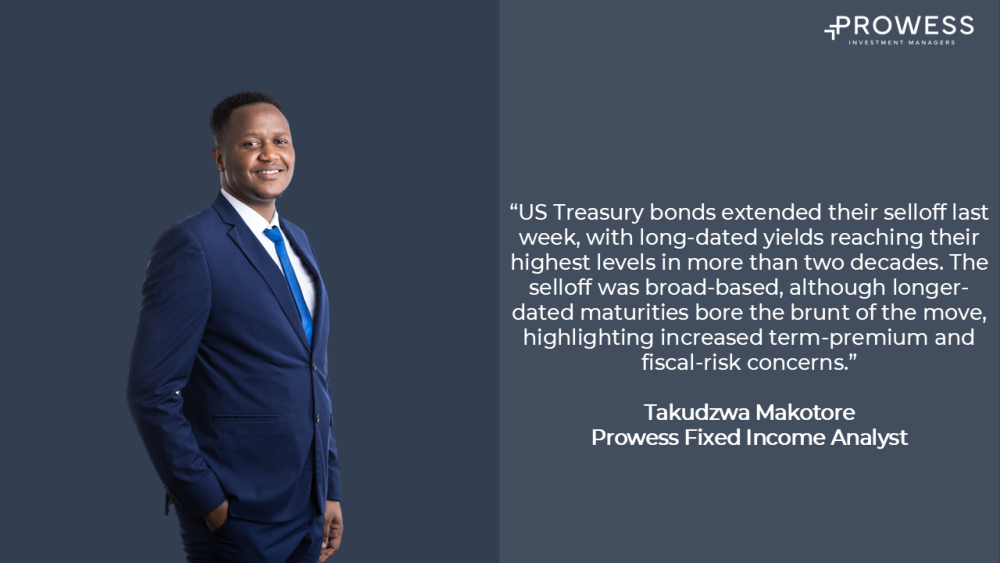
US Treasury bonds extended their selloff last week, with long-dated yields reaching their highest levels in more than two decades. The 30-year Treasury yield rose as much as 7bp to 5.47%, its highest level since 2004, while 5- to 30-year yields also reached multiyear highs. The move reflects growing concerns around persistent inflation, elevated US fiscal deficits and rising government debt. Geopolitical tensions have added to these pressures by pushing oil prices higher, increasing the risk of renewed inflation and potentially limiting the scope for monetary easing. The selloff was broad-based, although longer-dated maturities bore the brunt of the move, highlighting increased term-premium and fiscal-risk concerns.
Looking ahead, US PCE deflator data (the Federal Reserve’s preferred inflation measure) is due for release on Wednesday.
Local Market Developments
The SARB MPC delivered a 25 basis points hike to 7.25%, in line with our forecast and FRA pricing. The decision was unanimous and was driven by a re-intensification of the fuel price shock and higher global rates, reinforcing the need for a more restrictive policy stance. While the unanimous vote could be interpreted as a hawkish signal, the Governor’s comments suggest a more nuanced picture. The MPC considered both leaving rates unchanged and a larger 50bp hike, underscoring the uncertainty around the appropriate policy response to the current stagflationary environment. With inflation risks being driven primarily by energy prices and global developments, the balance of risks can change rapidly between meetings. Persistent energy-price pressures could keep the risk of further tightening alive.
August CPI came in softer than expected, but the inflation outlook remains increasingly fuel-sensitive. Headline CPI rose 0.1pp to 4.4% year-on-year, while core inflation eased to 4.1%. The downside surprise was largely driven by lower-than-expected municipal utility charges, rather than a broad-based moderation in underlying inflation. Importantly, the data provides some comfort that higher fuel prices have yet to generate meaningful second-round inflation effects. However, this is offset by the increasingly material direct fuel-price shock.
Looking ahead, South Africa’s producer price inflation numbers are due for release on Wednesday.s