

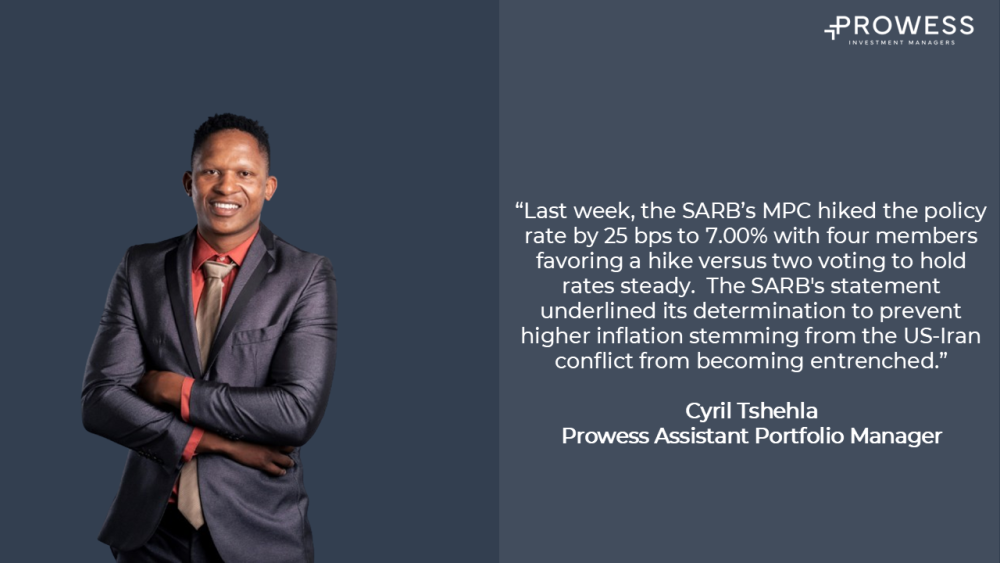
Globally, negotiations between the US and Iran continue without a deal being reached, while locally, the SARB’s MPC hiked the policy rate by 25 bps.
International Market Developments
Negotiations between the US and Iran towards a ceasefire extension or broader deal have continued, but without a final agreement. Both sides signalled progress, while also hardening their positions. Washington warned that it would be prepared to resume strikes if talks failed, while Tehran stressed that no settlement has been finalised, and it accused the US of imposing excessive conditions.
Dallas Fed President Lorie Logan warned that global supplies of oil and natural gas could begin to tighten if shipping through the Strait of Hormuz does not return to normal soon. Logan noted that US production would be unable to fully offset the shortfall in global oil supplies caused by the Iran war, citing constraints related to capital, labour, and other inputs. She added that consumers may need to adjust to a new reality in which critical fuel supplies are less readily available. She also warned that if shipping through the strait does not recover to pre-war levels soon, global consumption of oil and natural gas may need to decline more significantly than it has so far.
Local Market Developments
Locally, S&P Global on Friday affirmed SA’s sovereign long-term foreign currency rating at BB, while maintaining a positive outlook. The decision reflects growing confidence in SA’s improving fiscal trajectory, underpinned by stronger-than-expected revenue performance, continued expenditure restraint, and a third consecutive primary budget surplus in 2025/26. S&P expects fiscal consolidation to continue over the medium term, leading to a gradual decline in government debt as a share of GDP.
Last week, the SARB’s MPC hiked the policy rate by 25 bps to 7.00% with four members favoring a hike versus two voting to hold rates steady. The Governor confirmed that the committee had held a protracted discussion around the option of a 50 bps hike. The statement cautioned that although monetary policy does not have the tools to prevent the initial effects of supply shocks, it is crucial that central banks prevent higher inflation from becoming entrenched.
The committee noted that inflation risks had intensified, and that the challenge of large and overlapping shocks would likely trigger second round effects, requiring a monetary policy response. CPI inflation is expected to average 4.4% in 2026 and 3.7% in 2027, up from forecasts of 3.7% for 2026 and 3.3% for 2027 at the previous meeting.
The scenario of a longer closure of the Strait sees inflation at 5% and two more hikes than in the baseline, while the scenario that stacks all three risks see inflation peaking above 6% and requires three additional hikes.