

Globally, President Trump dismissed Iran’s peace proposal response as unacceptable and warned of potential renewed military action, while locally, rising global uncertainty has complicated the inflation outlook and made the future policy path less certain.
International Market Developments
Last week, the fragile ceasefire in the Middle East came under renewed strain after both the US and Iran fired missiles in the Strait of Hormuz. This led to US strikes on Iranian military infrastructure. President Trump insisted that the ceasefire remained in place but warned that far more forceful military action would follow if Iran rejected the proposed deal, while also observing that a deal could be reached any day.
Over the weekend, Iran formally responded to a US peace proposal prioritising an end to regional hostilities and securing access through the Strait of Hormuz. While rejecting demands to fully dismantle its nuclear infrastructure, Tehran proposed measures, such as transferring, or diluting part of, its enriched uranium stockpile. President Trump dismissed the response as unacceptable and warned of renewed military action. Washington continued to push for lasting nuclear restrictions and the reopening of the Strait of Hormuz shipping lanes.
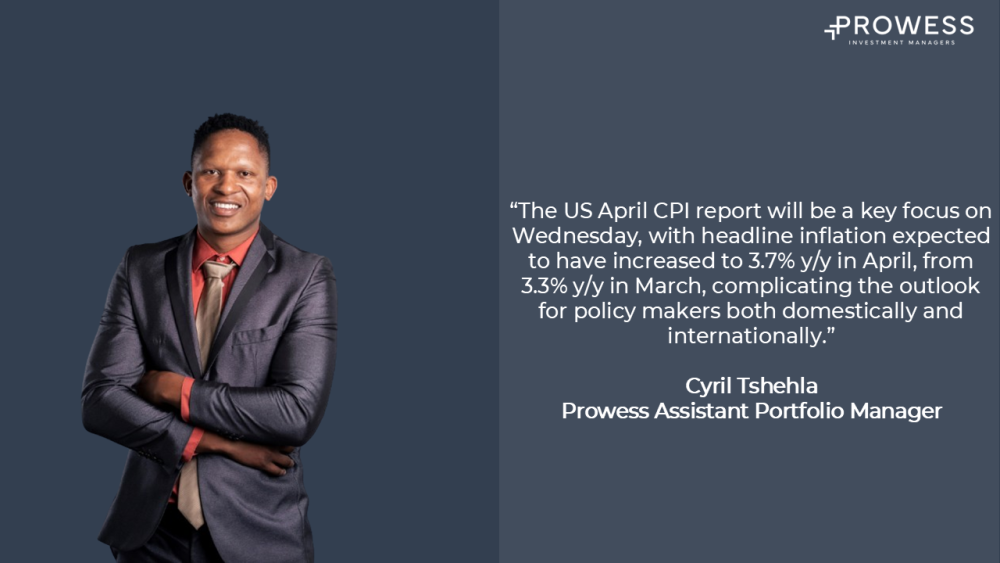
The US April CPI report will be a key focus on Wednesday. Headline inflation is expected to have increased to 3.7% y/y in April, from 3.3% y/y in March. On a m/m basis, CPI is expected to have increased by 0.6% in as April, following a rise of 0.9% in March. Chicago Fed President Austan Goolsbee cautioned against automatically cutting interest rates in the current environment. He noted that the appropriate policy response depends on whether the productivity gains are unexpected or anticipated.
Local Market Developments
SARB Governor Lesetja Kganyago commented that the central bank must retain full flexibility on interest rates amid a highly uncertain global environment. He highlighted that shocks, particularly the Middle East conflict driving higher oil prices, pose a significant upside risk to inflation. He also noted that inflation has begun to edge higher and that it could rise above 4% in the coming months.
Kganyago stressed that rising global uncertainty, particularly from the Iran war, has complicated the inflation outlook and made the future policy path less certain. He said that the central bank would very carefully monitor incoming data and would not pre-commit to an interest rate path. He emphasised instead its determination to ensure inflation returns to the 3% target. He also noted that the conflict has pushed up oil prices and disrupted energy and commodity markets, creating fresh inflation risks just as SA had successfully transitioned to a lower inflation target. He reiterated that the SARB remains fully committed to price stability, even as growth prospects may soften amid higher global energy costs.