

South Africa’s 2026 National Budget: Fiscal Consolidation Gains Momentum on Commodity Tailwinds
Finance Minister Enoch Godongwana will present the 2026 National Budget on Wednesday against a significantly improved economic backdrop. The rand trades near R15.99/$, bolstered by investor optimism, while government bonds have posted strong returns, reflecting cautious confidence. High precious-metals prices (gold above $4,900/oz, sharply higher platinum) and ongoing growth-oriented reforms have delivered a robust terms-of-trade boost and enabled faster fiscal progress than anticipated.
National Treasury expects a revenue overshoot of about R18 billion for 2025/26, with expenditure growth contained below Medium-Term Budget Policy Statement (MTBPS) projections. The main budget deficit is forecast to narrow to 4.2% of GDP (from the MTBPS target of 4.5%), improving further to around 3.0% in 2026/27. This would generate a primary surplus of 2.2% of GDP, allowing debt-to-GDP to peak at 77.8% in 2025/26 before declining. Strong performance stems from 10.4% revenue growth in the first three quarters (exceeding the 8.8% full-year target) and expenditure rising only 5.8% against an 8.3% forecast.
Six key themes to watch:
- Principles-led fiscal anchor: After wide consultations, Treasury favours a flexible, principles-based fiscal rule focused on transparency, accountability, and sustainability rather than strict numerical targets. Markets await any firm guidance or adoption timeline.
- Possible R20 billion tax hike for 2026/27: The MTBPS assumed R20bn in extra taxes, but commodity windfalls provide a buffer. The Minister may reduce or eliminate this through higher collections and lower debt-service costs, balancing credibility against calls for relief.
- Expenditure savings of R6.7 billion: The Targeted and Responsible Savings (TARS) initiative has identified R7bn in efficiencies. Expect details on spending reviews, cutting of low-priority programmes, and reallocation of funds to infrastructure.
- Workforce savings and ghost-worker purge: Audits have identified nearly 9,000 employees with multiple salaries or anomalies. Paired with the Early Retirement Programme (R5.5bn allocated), this could yield over R5bn annually in payroll savings.
- Better municipal capital allocation: A new programme will ring-fence trading services, tie funding to reforms, and curb infrastructure-grant underspending to boost service delivery and growth.
- Debt issuance adjustments: Lower borrowing needs (potentially R100bn+ less over years, thanks to ending Eskom relief, revenue gains, and deficit reduction) may lead to reduced weekly nominal bond auctions (from R3bn toward R2.5bn). Diversification into infrastructure bonds, FRNs, and Treasury bills will ease curve pressure and build buffers.
The Budget will also advance infrastructure: updated PPP rules, unsolicited proposals, a new quarterly Budget Facility window, the Credit Guarantee Vehicle (R2bn seed capital), and an infrastructure bond. SOE support continues declining, with growing private involvement in rail, ports, water, and energy.
Credit implications are favourable. S&P’s recent upgrade and positive outlook increase chances of another notch soon; Moody’s and Fitch may follow if debt stabilisation holds.
The 2026 Budget lands on stronger ground than expected six months ago, thanks to commodity revenues, spending discipline, and reform progress. This enables credible consolidation without severe austerity. Risks include political pressures before local elections, potential grant expansions, and converting windfalls into growth rather than consumption.
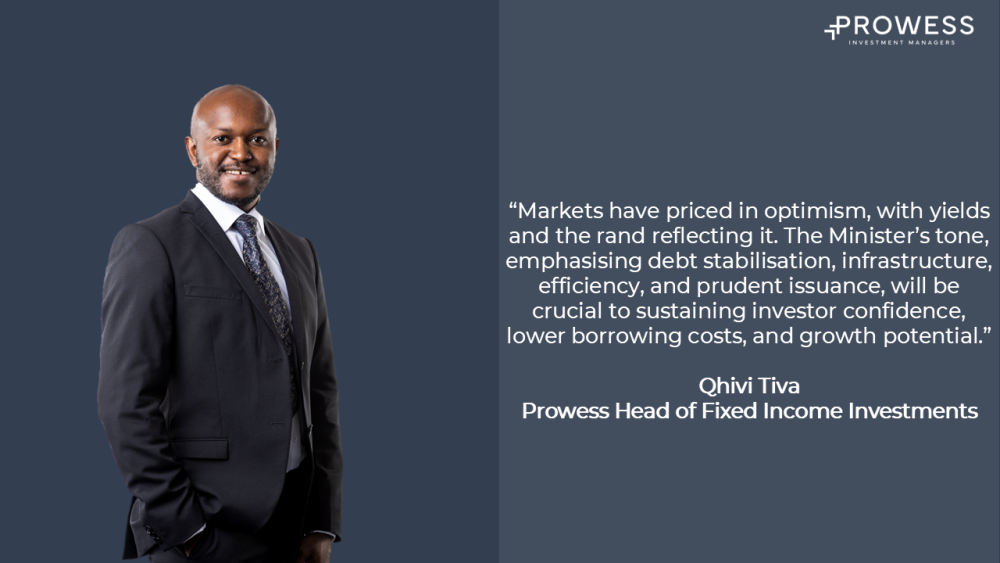
Markets have priced in optimism, with yields and the rand reflecting it. The Minister’s tone, emphasising debt stabilisation, infrastructure, efficiency, and prudent issuance, will be crucial to sustaining investor confidence, lower borrowing costs, and growth potential.