

Finance Minister Enoch Godongwana delivered the 2026 National Budget yesterday, presenting a markedly improved fiscal picture compared to recent years. Bolstered by high precious-metals prices, stronger revenue collections, and disciplined spending, the budget achieves debt stabilisation for the first time in 17 years while advancing structural reforms and infrastructure investment.
Our pre-budget preview anticipated a revenue overshoot of ~R18 billion for 2025/26, contained expenditure growth, and a main budget deficit narrowing to 4.2% of GDP. The speech confirmed and strengthened this trajectory: the consolidated deficit improves to 4.5% of GDP in 2025/26 (better than earlier estimates), falls to 4% in 2026/27, and reaches 3.1% by 2028/29. Gross debt peaks at 78.9% of GDP this year, slightly higher due to strategic borrowing amid strong investor demand, then declines to 77.3% in 2026/27 and 76.5% by 2028/29. The primary surplus grows from 0.9% of GDP in 2025/26 to 2.3% by 2028/29, reinforcing sustainability.
Economic growth is projected at 1.6% in 2026 (up from 1.4% in 2025), averaging 1.8% over the medium term and reaching 2% by 2028. Reforms under Operation Vulindlela continue to ease energy, logistics, local government, and spatial constraints, supporting the four pillars of macroeconomic stability, structural change, infrastructure, and state capacity.
Strong revenue performance, R21.3 billion higher than the 2025 Budget estimate, driven by VAT, corporate income tax, and dividends tax, enabled the complete withdrawal of the previously flagged R20 billion tax increase for 2026/27. This delivers meaningful relief without compromising fiscal credibility.
Key tax measures include:
- Full inflation adjustment to personal income tax brackets and rebates, ending bracket creep.
- Tax-free savings account annual limit raised from R36,000 to R46,000.
- Retirement fund deduction limit increased from R350,000 to R430,000.
- VAT registration threshold hiked from R1 million to R2.3 million to ease pressure on small businesses.
- Capital gains tax exemption for small business sales (older persons) raised from R1.8 million to R2.7 million.
Modest inflationary increases apply to excise duties on tobacco and alcohol, and fuel levies (general fuel levy +9c/l petrol, +8c/l diesel; RAF +7c/l; carbon levy +5–6c/l).
The Targeted and Responsible Savings (TARS) initiative identified R12 billion in medium-term savings through efficiency gains, fraud reduction (e.g., 35,000 fraudulent social grants terminated), and programme reprioritisation. The Public Transport Network Grant is scaled down by R8.4 billion over three years due to poor outcomes, with funds redirected to judiciary, border management, defence, and statistics capacity.
Total spending reaches R2.67 trillion in 2026/27, with over 60% allocated to the social wage. Social grants rise: old age, disability, and care dependency grants increase by R80 to R2,400; child support by R20 to R580 (R292.8 billion total). Health receives R26 billion for HIV/AIDS programmes and R21.3 billion for staffing and goods; early childhood development gets R12.8 billion over three years to reach 300,000 more children.
Infrastructure investment exceeds R1 trillion over the medium term, with R577 billion by public entities, R218 billion by provinces, and R206 billion by municipalities. Focus areas include SANRAL road maintenance, PRASA corridor recovery (targeting 250–450 million annual passenger trips), Transnet rail capacity restoration, bulk water schemes, and energy security. The Credit Guarantee Vehicle for transmission infrastructure is progressing toward operational status, supported by World Bank collaboration.
Public-private partnerships advance with streamlined regulations and a growing pipeline of 63 projects, including six border posts nearing financial close. The Budget Facility for Infrastructure has approved R21.9 billion for key projects, while municipal reforms ring-fence trading-service revenues (R27.7 billion allocated) for reinvestment in water, electricity, sanitation, and waste, while underperforming municipalities shift to indirect delivery models.
Peace and security spending rises, with additional funds for border management (R990 million), defence operations, police, and anti-organised-crime efforts. The budget also supports financial sector modernisation, crypto-asset capital-flow rules, unclaimed benefits administration, and data infrastructure as a critical economic enabler.
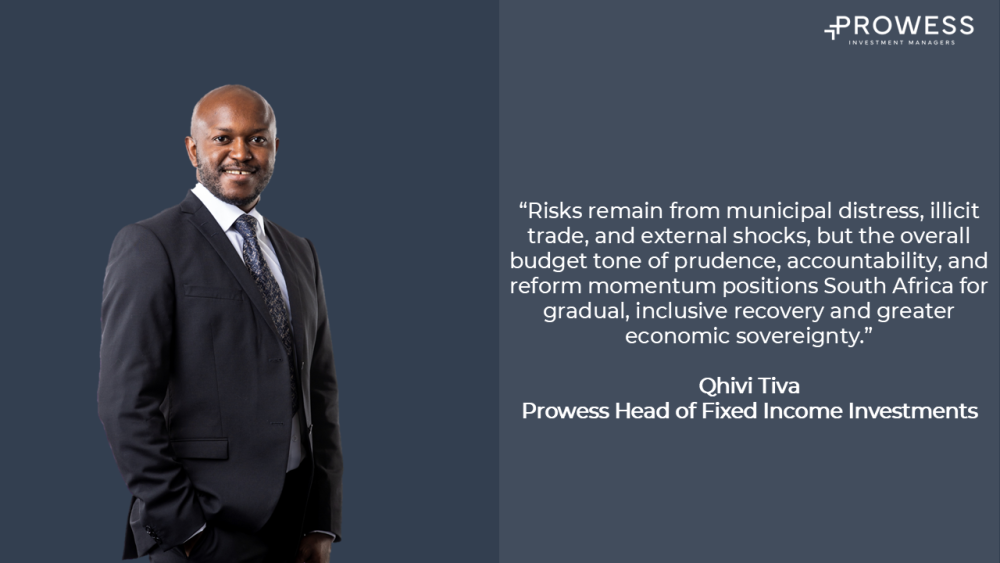
The 2026 Budget reflects restored credibility, as evidenced by the recent credit upgrades, FATF grey-list removal, and lower borrowing costs, while avoiding severe austerity. It balances debt stabilisation, targeted relief, efficiency savings, and growth-enhancing investment. Risks remain from municipal distress, illicit trade, and external shocks, but the overall tone of prudence, accountability, and reform momentum positions South Africa for gradual, inclusive recovery and greater economic sovereignty.