

Last week, the Federal Reserve kept interest rates unchanged, in line with our expectations. Locally, the SARB acted in tandem, leaving the repo rate unchanged at 6.75% in a dovish-leaning decision, again in line with expectations.
International Market Developments
Last week, the US Federal Reserve kept interest rates unchanged, in line with broad market expectations. Fed Chair Jerome Powell pointed to resilient labour market conditions and inflation that remains slightly above target as justification for delaying rate cuts for now. Despite the pause, political pressure on the central bank has intensified, with President Donald Trump publicly calling for lower rates. Notably, Trump-appointed Governors Christopher Waller and Stephen Miran dissented at the meeting, advocating for a 25-basis point rate cut. Powell emphasised that the Fed has already made meaningful progress on policy normalisation. “Since last September, we have lowered our policy rate by 75 basis points, bringing it within a range of plausible estimates of neutral,” he said. He added that this stance should help stabilise the labour market while allowing inflation to continue trending toward the 2% target once the effect of recent tariff increases work through the system.
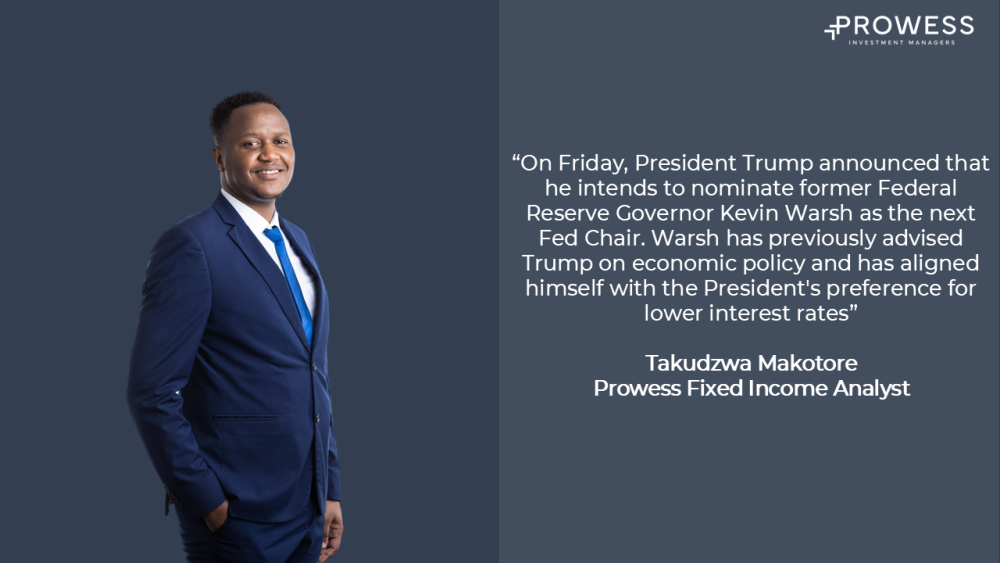
Powell stressed that future policy decisions will remain data dependent. “We are well positioned to determine the extent and timing of additional adjustments to our policy rate based on the incoming data, the evolving outlook and the balance of risks,” he noted. Powell is due to step down as Fed Chair in June when his term expires. On Friday, President Trump announced that he intends to nominate former Federal Reserve Governor Kevin Warsh as the next Fed Chair. Warsh has previously advised Trump on economic policy and has aligned himself with the President’s preference for lower interest rates.
Looking ahead, US non-farm payroll data is due for release on Friday.
Local Market Developments
Last week, the SARB kept the repo rate unchanged at 6.75% in a dovish-leaning decision, with two MPC members voting for a cut, as inflation forecasts were modestly revised lower and confidence in achieving the 3% target over the medium term was reaffirmed. Headline CPI is now expected to average 3.3% in 2026, easing to 3.2% in 2027 and 3.0% in 2028, while core inflation remains contained, supporting the view that policy is moderately restrictive. Growth forecasts were left unchanged, with consumption continuing to drive activity amid still-weak fixed investment, although a rebound in Q3:25 offers some encouragement. The SARB’s QPM continues to signal gradual rate cuts, with the repo rate projected at 6.31% by end-2026, slightly higher than previously, implying a cautious and shallow easing cycle. While risks to the inflation outlook are assessed as balanced, concerns around food and electricity costs persist, and Governor Kganyago emphasised that future rate decisions will remain data-dependent and taken on a meeting-by-meeting basis.
Looking ahead, the S&P Global South Africa PMI index is due to be released. The index tracks business trends across private sector activity, including mining, manufacturing, services, construction and retail.