

Geopolitical tensions continue to escalate this week as the US issued a 48-hour ultimatum demanding Iran reopen the Strait of Hormuz, with Treasury Secretary Scott Bessent stating President Trump is prepared to “take whatever steps it takes” to achieve US objectives, including neutralising Iran’s air force and navy. Iran warned of retaliation targeting regional energy, desalination, and IT infrastructure. Markets responded with risk-off flows amid fears of a prolonged energy shock. Central banks globally held rates steady while highlighting upside inflation risks. Locally, February CPI surprised lower at 3.0% y/y, but the Iran conflict is set to trigger sharp fuel-price hikes and force the SARB into wait-and-see mode.
International Market Developments
Major central banks maintained policy restraint amid the Iran war’s impact on energy prices and inflation expectations.
The US FOMC kept the Fed funds rate unchanged at 3.50-3.75%, as expected. Policymakers grappled with conflicting signals: inflation expectations were revised higher on surging energy prices linked to the Iran war, while the labour market showed softening. The decision was not unanimous, with one member dissenting in favour of a cut. Guidance was maintained for only one rate cut in 2026. Chair Jerome Powell emphasised a cautious “wait-and-see” stance as geopolitical risks cloud the inflation and activity outlook.
The IMF warned that the surge in energy prices driven by the Iran war poses significant downside risks to the global economy. Oil and gas supply disruptions have already pushed prices above $100/bbl. Every 10% sustained rise in oil prices adds 40 bps to inflation and weighs on output; the overall fallout will depend on the duration and intensity of the conflict. The Fund is closely monitoring transmission channels through commodity prices, inflation expectations, and financial markets.
Local Market Developments
The war in the Middle East is creating major economic challenges for South Africa, with the Strait of Hormuz effectively closed (except limited Iranian exports to China). Minister of Mineral and Petroleum Resources Gwede Mantashe confirmed government engagement with fuel suppliers to stabilise supply chains and noted price increases are “increasingly unavoidable,” while stressing exploration of alternative sources without immediately tapping strategic reserves. South Africa’s strategic reserves are too small to buffer the shock (19 days of crude, 15 days of refined products) and remains at risk of potential longer-term shortages due to the growing reliance on imported refined fuels.
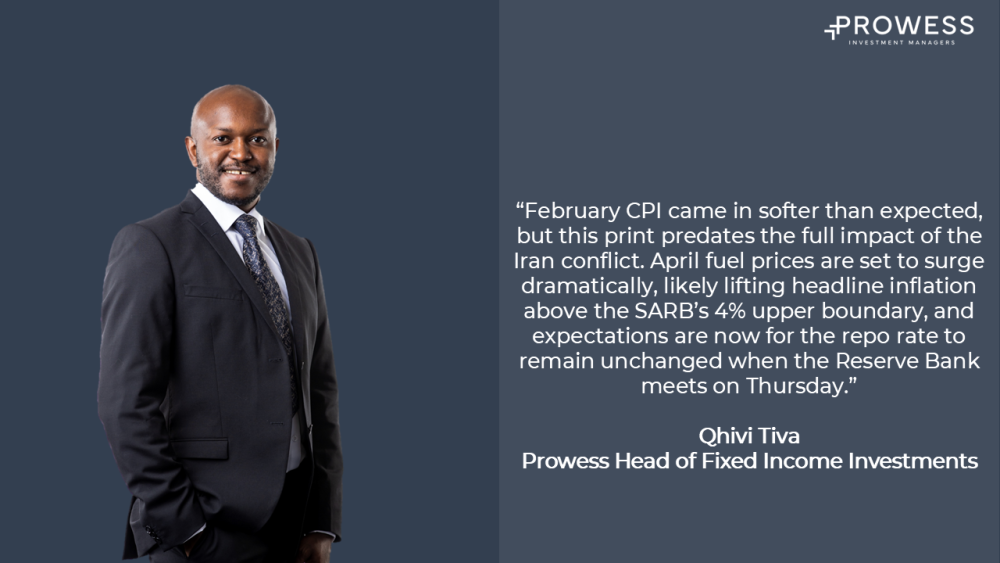
February CPI came in softer than expected at 3.0% y/y (from 3.5% in January), with core inflation also at 3.0% y/y. On a monthly basis, headline inflation rose 0.4%. However, this print predates the full impact of the conflict. April fuel prices are set to surge dramatically which is likely to lift headline inflation above the SARB’s 4% upper bound.
The SARB meets on Thursday and is now widely expected to leave the repo rate unchanged at 6.75%, shifting from our prior cut expectation into explicit wait-and-see mode. Forward rate agreements have repriced sharply to 75 bp of hikes by early 2027 (from pre-conflict pricing of 50 bp of cuts).