

Introduction
The Middle East conflict has re-emerged as the dominant driver of global markets. The 60-day memorandum of understanding signed in June lapsed on 17 August without extension, and Brent crude has climbed from below US$80 a barrel in early August to above US$91. Cutting against that, US data have softened materially, pulling odds of a September Federal Reserve hike back to roughly 42% and the dollar below 100 on the DXY. The result is a live energy supply shock layered on visibly cooling demand.
Global Economic Developments
July was a month of coordinated caution, with the European Central Bank, the Bank of England (3.75%), the Bank of Japan (1.00%) and the Federal Reserve (3.50%–3.75%) all on hold. Three regional Fed presidents dissented in favour of a hike, a rare cluster of opposition to the majority. The data have since moved against the hawks: July CPI rose 3.4% year-on-year with core at a five-month low of 2.5%, while non-farm payrolls contracted by 23,000, a second consecutive month of negative or near-zero growth. The US ten-year nevertheless remains firm near 4.68%. The July FOMC minutes (19 August) and Chair Warsh’s first Jackson Hole keynote (27–29 August) are the near-term swing events.
Elsewhere, euro area inflation eased to 2.8% in June, UK inflation to 2.6%, Japanese core rose to 1.6% and Chinese CPI to 1.0%.
Geopolitics and Commodities
Hormuz talks stalled on Iran’s demands for reparations, sanctions relief and an end to the US blockade. Iran and Oman continue to negotiate a shipping arrangement, but Washington is not party to it and wants unrestricted passage. The EIA expects Brent to average US$87 in 2026, with regional production below pre-conflict levels until early 2027.
In July, the Economist all-commodities index rose 2.09% month-on-month and Brent 20.53%. August has been dominated by precious metals, with gold up more than 10% to near US$4,380 an ounce — a favourable terms-of-trade mix for South Africa.
South Africa
Headline CPI slowed to 4.3% in July from 5.0% in June, the first decline in five months and below the 4.5% consensus, with prices up 0.2% month-on-month against 0.7% previously. Three factors drove it: food and non-alcoholic beverage inflation fell to 0.9%, the lowest in more than sixteen years on a record maize harvest; municipal tariff increases were restrained; and petrol and diesel fell 7.1% and 11.7% on the month, pulling transport inflation to 8.9% from 12.7%. Inflation nonetheless remains well above the Reserve Bank’s 3% objective. The Monetary Policy Committee held at 7.00% on 23 July on a 4–2 vote, surprising a market priced for a hike, cutting its 2026 CPI forecast to 4.0% while retaining a hawkish framing. Mining output fell 4.0% year-on-year in June and unemployment rose to 33.6% from 32.7%, though the fiscal accounts surprised positively with a record R80.13 billion surplus.
Market Review
The nominal curve sold off 27 basis points on average in July, with the front end, belly and back end weaker by 14, 33 and 36 basis points, while linkers sold off 18. The 12×15 FRA ended 63 basis points above three-month Jibar, implying 50 basis points of hikes priced over twelve months.
August has reversed much of this. The ten-year benchmark, which touched 8.9% in late July following the SARB’s surprise hold, fell to 8.47% on 5 August and has since held an 8.43%–8.57% range. Non-residents bought a net R23.1 billion of government debt in the first week of August, the largest weekly inflow since January, and the rand has firmed to around R16.25. Local bonds rallied despite higher crude because the global rates repricing was the larger force.
Outlook
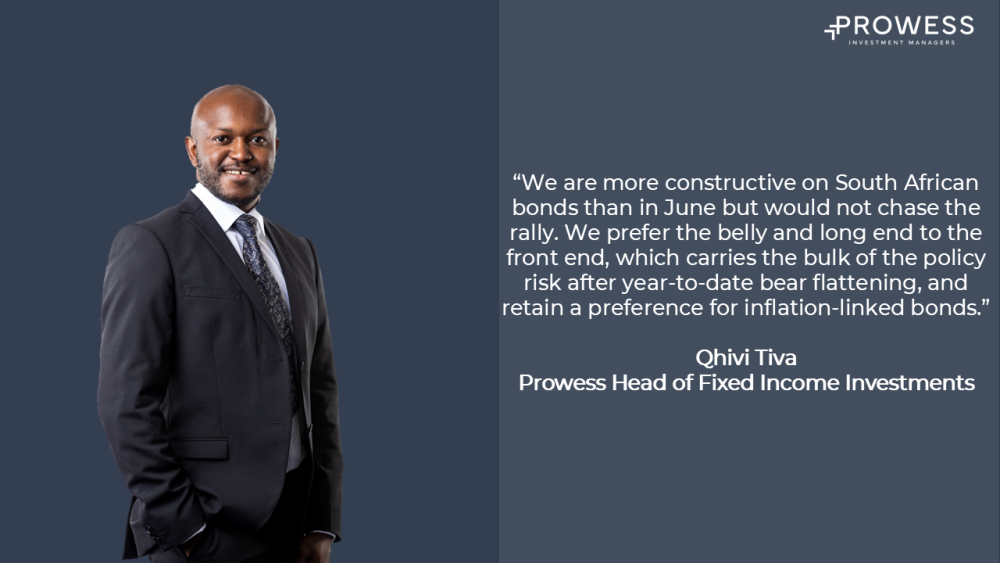
We are more constructive on South African bonds than in June but would not chase the rally. Our base case is a SARB hold in September, with low conviction; we regard the 50 basis points of tightening embedded in the FRA strip as too much if crude stabilises near US$87 and too little if Hormuz remains closed into the fourth quarter. We prefer the belly and long end to the front end, which carries the bulk of the policy risk after year-to-date bear flattening, and retain a preference for inflation-linked bonds. The principal risks are external: Brent towards US$100–120, a hawkish Jackson Hole lifting US yields back towards 4.85%, and the reversal of fast-money inflows. Into 2027 our view is unchanged — yields moderate as growth improves, fiscal consolidation continues and inflation re-anchors nearer target.