

Introduction
Corporate South Africa sits on a mountain of cash, well over a trillion rand across JSE-listed companies, built up over two decades of load-shedding, logistical headaches, and policy unpredictability. While this liquidity has provided a vital buffer, its deployment reveals a telling story with much of it flowing into offshore acquisitions or generous dividends rather than domestic expansion. The result is a silent erosion of returns. Parking large balances in low-yielding call or notice deposits may feel safe, but it exerts a measurable drag on Return on Equity (ROE) and represents a significant opportunity cost in a capital-constrained economy.
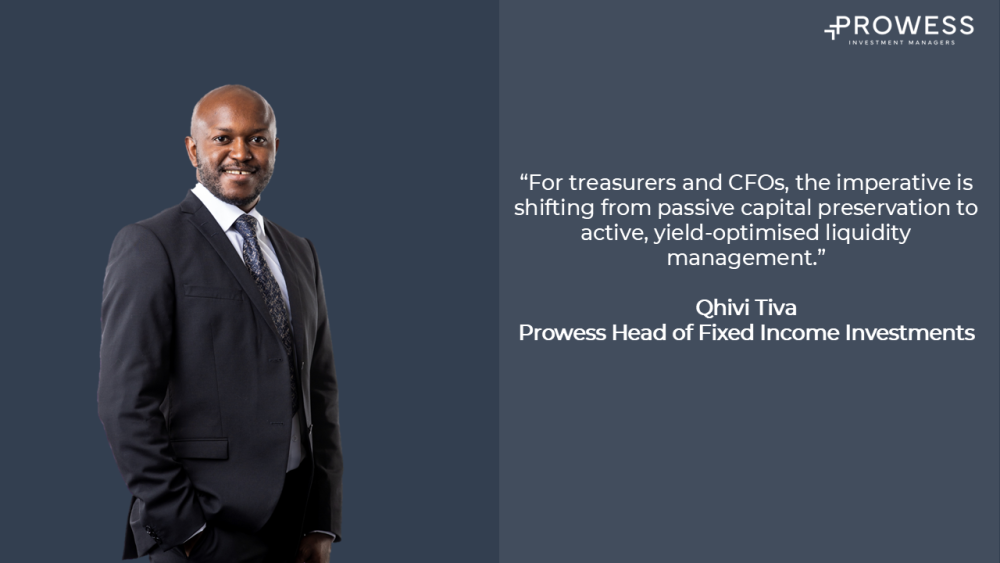
For treasurers and CFOs, the imperative is shifting from passive capital preservation to active, yield-optimised liquidity management.
The Limitations of Traditional Tools
The classic South African corporate toolkit, call accounts, notice deposits, and fixed deposits, offers simplicity and familiarity. Yet each comes with clear trade-offs. Call deposits provide immediate access but deliver chronically low rates. Notice and fixed deposits improve yields marginally while locking up cash and reducing flexibility when unexpected payment cycles or opportunities arise.
Concentrating large deposits with one or two banks also heightens counterparty risk, an issue increasingly scrutinised by boards and risk committees amid evolving credit conditions in the local banking sector.
Money Market Funds: A Better Balance
Institutional money market funds (MMFs) present a compelling alternative that largely resolves the traditional liquidity-versus-yield dilemma while enhancing risk management.
Well-structured MMFs provide several distinct advantages, particularly evident in a rate hike cycle. As interest rates rise, MMFs can rapidly reposition portfolios to capture higher yields on new instruments such as NCDs and commercial paper, allowing corporates to benefit quickly from elevated rates, unlike fixed deposits that lock in lower yields for extended periods.
Key benefits include:
- Superior yields at scale: By accessing negotiable certificates of deposit (NCDs), commercial paper, short-dated government securities, and high-grade state-owned entity paper, MMFs can deliver consistently better returns than retail-style bank deposits. Active portfolio management and yield curve positioning further enhance performance across interest rate cycles.
- True daily liquidity: Quality institutional funds maintain tight Weighted Average Maturity (WAM) and Weighted Average Life (WAL) limits, typically offering T+1 liquidity. This aligns far more effectively with corporate cash flow rhythms than rigid 30-, 60-, or 90-day term deposits.
- Built-in diversification: A single MMF allocation spreads exposure across multiple counterparties and issuers, reducing concentration risk without adding significant operational burden, a key consideration for governance-conscious organisations.
Importantly, success in this space is not passive. Alpha in short-term fixed income stems from rigorous credit underwriting, duration management, instrument selection, and real-time liquidity oversight. South Africa’s unique macro dynamics, from electricity supply volatility to SARB policy responses and sovereign risk spreads, require specialist local expertise.
A Practical Roadmap for Treasurers
Leading corporates are already adopting a more sophisticated approach to working capital. A structured framework includes:
- Segment liquidity pools — Categorise cash into operational (0–7 days), reserve (8–90 days), and strategic (90–365 days) buckets, each with tailored mandates and risk tolerances.
- Establish clear policy guardrails — Define minimum liquidity thresholds, counterparty limits, approved instruments, and stress-testing protocols for rate shocks, credit events, and redemption pressures.
- Position MMFs as core holdings — Use institutional-grade funds with transparent portfolios, conservative maturity limits, strong daily liquidity profiles, and independent oversight for the reserve liquidity sleeve.
- Insist on robust reporting — Regularly track gross and net yields against benchmarks, look-through credit exposures, duration metrics, and liquidity profiles. Link performance to broader ROE and working capital KPIs.
- Diversify managers and strategies — Avoid over-reliance on any single fund or provider to smooth returns through different rate environments.
- Streamline operations — Implement straight-through processing, reliable T+1 settlement, and integrated cash forecasting to minimise idle balances.
From Defence to Contribution
The potential strategic payoff is significant: higher and more resilient income from non-core cash holdings, combined with strengthened governance through diversified, policy-driven liquidity management. In an environment where every basis point matters to shareholder value, leaving substantial cash in low-yield deposits is no longer just conservative, it represents a clear drag on performance.
Corporate South Africa does not need to abandon its hard-earned caution. It needs to professionalise cash as an asset class. By transitioning from static safety to active liquidity management, working capital can move from a quiet diluter of returns to a visible contributor to sustainable performance.
Prowess Investment Managers, named ABSIP Best Black Fund Manager / Team of the Year – Fixed Income 2025, brings deep specialist expertise to this space. With a strong track record in short-term fixed income, its money market offerings have delivered consistent outperformance. Prowess is actively looking to partner with South African corporates to deliver tailored money market solutions that enhance yield, preserve liquidity, and strengthen governance in line with each organisation’s specific cash flow and risk requirements.