

Last week, central banks took centre stage as the Iran conflict kept energy prices elevated. The US Federal Reserve raised rates for the first time since 2023 and the Bank of Japan hiked to a 31-year high, while the Bank of England held rates on a split vote. In South Africa, retail sales surprised to the upside and consumer confidence improved ahead of this week’s inflation print and SARB rate decision.
International Market Developments
The Iran conflict showed little sign of de-escalation. Planned talks in Oman on the governance of the Strait of Hormuz were postponed, Iran rejected US calls to restart formal peace negotiations, and disruptions across the Strait of Hormuz and Red Sea shipping lanes persisted. Brent crude climbed above $109/bbl on Monday after attacks forced Saudi Arabia to close its East-West pipeline, before easing to around $103/bbl by Thursday on reports of additional Saudi crude cargoes being routed through Oman. Oil remains up close to 70% year-to-date.
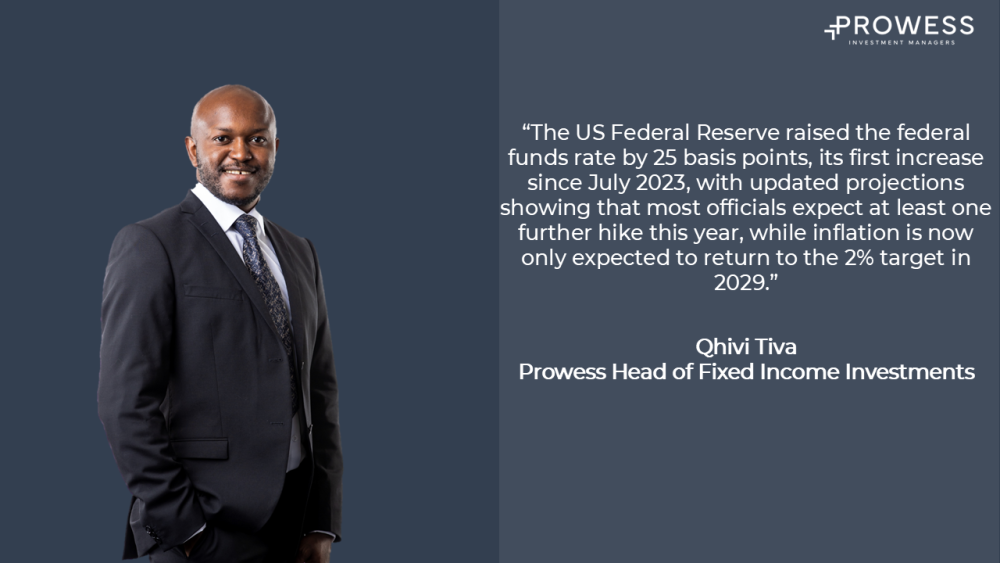
The US Federal Reserve raised the federal funds rate by 25 basis points in a unanimous decision, its first increase since July 2023 and the first policy decision under Chair Kevin Warsh. Updated projections show most officials expect at least one further hike this year, which would take the target range to 4.00%–4.25%, while inflation is now only expected to return to the 2% target in 2029. The US 10-year Treasury yield briefly breached 5% early in the week, its highest level since 2007, before easing to 4.94% by Thursday.
The Bank of England kept its Bank Rate unchanged at 3.75% for a sixth consecutive meeting, but the 6–3 vote, with three members favouring a hike to 4.0%, signalled growing support for tightening after UK CPI rose to a five-month high of 3.1% in August. The Bank of Japan raised its policy rate by 25 basis points to 1.25%, the highest level since 1995, citing upside risks to inflation. However, two dissenting votes weakened the yen as markets questioned the pace of further tightening.
Looking ahead, attention will remain on energy supply developments in the Gulf and on Fed communication for guidance on the pace of further tightening.
Local Market Developments
Looking ahead, August CPI and the SARB’s interest rate decision, both due on Wednesday, will be key. Headline inflation is expected to rise to 4.5% from 4.3% in July, and with two MPC members having voted for a hike in July, markets are split between a hold and a 25 basis point increase.
The BER’s third-quarter survey showed inflation expectations holding steady, with respondents anticipating average inflation of 4.4% in 2026, while expectations for 2027 eased to 4.0% from 4.2%. Separately, the BER consumer confidence index improved to -13 in the third quarter from -19, with gains across all income groups, although elevated fuel costs and the prospect of higher interest rates continue to weigh on sentiment.
National Treasury has drafted legislation for a new fiscal anchor aimed at strengthening spending discipline, with further detail expected in the Medium-Term Budget on 21 October.