

Last week, Donald Trump issued a Strait of Hormuz ultimatum amid fragile ceasefire talks. Locally, President Cyril Ramaphosa reaffirmed South Africa’s position as a leading destination for foreign direct investment ahead of this week’s sixth South Africa Investment Conference (SAIC).
International Market Developments
Last week, escalation risks in the Middle East intensified after Donald Trump issued a renewed ultimatum to Iran, demanding the country reopen the Strait of Hormuz or face severe military retaliation, including threats Iran’s power infrastructure. The statement, delivered via social media, followed the high-profile rescue of a US airman whose fighter jet had been shot down, an incident that has challenged perceptions of US military dominance amid the evolving conflict. Iran responded firmly, stating that “no rational person” would agree to a ceasefire under current conditions. However, according to Axios, backchannel discussions involving the US, Iran, and regional mediators are exploring the framework for a potential 45-day ceasefire.
Meanwhile, activity through the Strait of Hormuz has surged to its highest levels since the onset of the conflict, signalling tentative normalization in energy flows. Oil tankers carrying Iraqi crude have resumed transit following Iran’s reported exemption for its neighbour, while liquefied natural gas shipments from Qatar are attempting their first exports beyond the region since hostilities began.
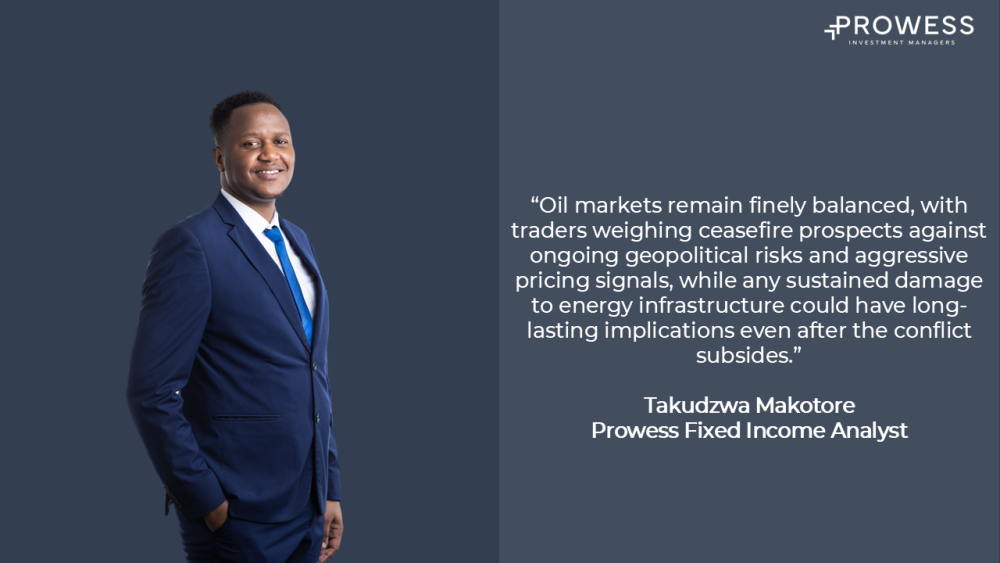
Oil markets remain finely balanced. Prices have stabilized as traders weigh ceasefire prospects against ongoing geopolitical risks and aggressive pricing signals from Saudi Arabia. OPEC+ cautioned that any sustained damage to Middle Eastern energy infrastructure could have long-lasting implications for global supply, even after the conflict subsides.
The global spillover effects are becoming increasingly visible. In Italy, authorities have begun imposing fuel supply limits at select airports: one of the earliest indications that disruptions to Persian Gulf exports are translating into operational constraints in Europe, a key importer of jet fuel from the region.
Looking ahead, the US Personal Consumption Expenditure Price Index is scheduled to be released on Thursday.
Local Market Developments
Last week, President Cyril Ramaphosa reaffirmed South Africa’s position as a leading destination for foreign direct investment ahead of this week’s sixth South Africa Investment Conference (SAIC), where delegates from more than 50 countries are expected to convene. The event continues to serve as a key platform for showcasing the country’s economic potential and attracting global capital.
In his weekly newsletter, the President emphasised that South Africa offers a compelling investment proposition, supported by a diversified industrial base, a well-established policy and regulatory framework, and its strategic role as a gateway to the broader African continent. These structural advantages, he argued, continue to differentiate the country in an increasingly competitive global investment landscape. President Ramaphosa highlighted the significant progress made since the launch of the government’s R1.2 trillion investment mobilisation drive, noting that substantial pledges have already been secured across a range of sectors. These include mining, healthcare, automotive, food and beverages, and renewable energy, with the latter reinforcing South Africa’s position as a leading hub for clean energy investment on the continent.
He further pointed to improving macroeconomic fundamentals and ongoing structural reform efforts as key factors underpinning growing investor confidence. Together, these developments signal a positive trajectory for the country’s investment outlook, even amid a challenging global economic environment.
Looking ahead, manufacturing production statistics are due for release on Thursday.