

Last week, President Donald Trump’s reform agenda suffered a setback after a US trade court ruled that most of the recently introduced global tariffs were illegal. Locally, the Monetary Policy Committee (MPC) of the SA Reserve Bank (SARB) decided to cut the repo rate by 25 basis points to 7.25% (prime to 10.75%).
International Market Developments
In a setback for Donald Trump’s reform agenda, a U.S. trade court has ruled that most—though not all—of the newly introduced global tariffs are illegal. The White House has announced plans to appeal the decision, and the appeals court has allowed the tariffs to remain in effect while the legal process continues. The ruling affects the Liberation Day reciprocal tariffs as well as separate duties imposed on Canada, China and Mexico. Of particular relevance to South Africa, tariffs on foreign cars, steel, and aluminium—justified on national security grounds—remain legally valid. However, this has raised concerns among U.S. investment banks, who caution that the administration might try to reclassify some tariffs under still-permitted legal frameworks.
Over in Asia, long-term yields in Japan sold off but remain elevated, following another government bond auction that saw tepid demand. Investors are increasingly uneasy about Japan’s fiscal position—its debt-to-GDP ratio hovers around 250%—and the apparent end of its prolonged deflationary period suggests that interest rates may need to rise. However, this creates additional challenges, as higher yields translate into lower bond prices. This poses a risk for Japanese authorities, particularly the central bank, which holds roughly half of all government debt—now losing value. Policymakers are expected to step in to help manage these risks. At the same time, higher domestic yields could prompt Japanese investors to repatriate funds currently invested abroad, including in U.S. assets.
Looking ahead, US nonfarm payroll numbers are due on Friday. Investors will be looking for clues on the impact of uncertainty created by global tariffs on the labour market.
Local Market Developments
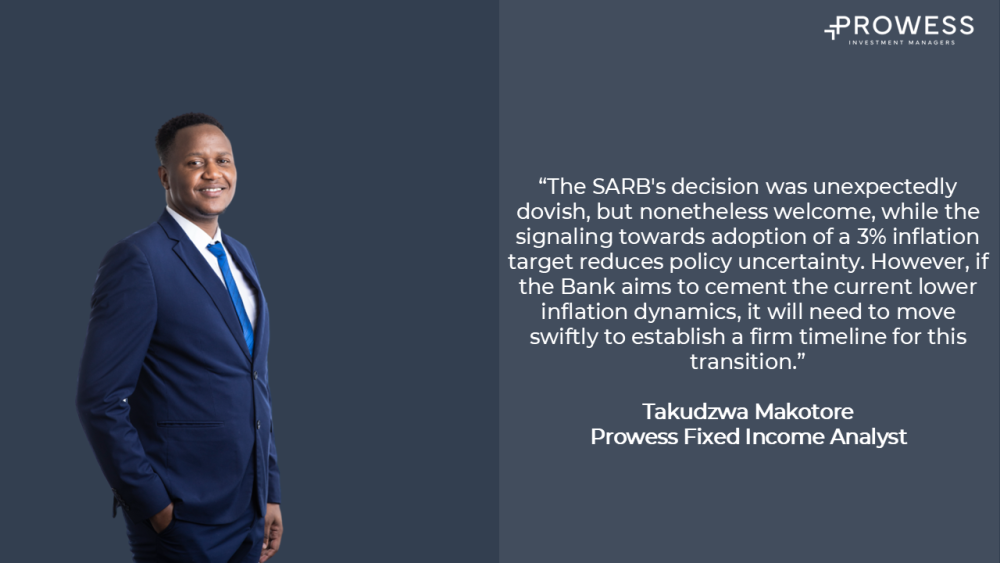
Last week, the Monetary Policy Committee (MPC) of the South African Reserve Bank (SARB) cut the repo rate by 25 basis points to 7.25%, bringing the prime lending rate to 10.75%. The unanimous decision — with all six members voting in favour of the cut and one even supporting a 50-basis point reduction. The decision was unexpectedly dovish, but nonetheless welcome. Moreover, the SARB’s clear signaling toward adopting a 3% inflation target is a positive step that reduces policy uncertainty. However, if the Bank aims to cement the current lower inflation dynamics, it will need to move swiftly to establish a firm timeline for this transition. Local bond yields fell after the SARB interest rate decision. In addition to the repo rate cut, the signalled intention to move to a lower target over time likely also contributed. Meanwhile, the Rand strengthened against all major currencies this week, not just against the US dollar.
Looking ahead, this week is a busy one on the domestic calendar, with several important data releases for Q1 and Q2 scheduled. On Tuesday, 2025Q1 GDP figures are due to hit the wire. Consensus sees a 0.2% quarter-on-quarter expansion following the 0.6% growth rate recorded in 2024Q4.