

Last week, escalation in the Middle East continued to drive market volatility with no credible peace deal in sight. Locally, financial markets were not spared from the global risk-off wave, as escalating tensions in the Middle East spilled over into domestic assets, triggering a broad-based sell-off across equities and bonds.
International Market Developments
Last week, continued instability in the Middle East drove heightened market volatility and reinforced a risk-off sentiment. On Friday, President Trump escalated tensions by threatening Iran with further military action after its leadership signalled no intention to de-escalate the conflict. He warned that the US possesses “unparalleled firepower, unlimited ammunition, and plenty of time.” In response, Iran’s leader, Mojtaba Khamenei, stated that Tehran may open additional fronts should the US and Israel persist with their current offensive. Against this backdrop, oil prices closed the week at $99.75/bbl, bringing the year-to-date increase to 64.0%.
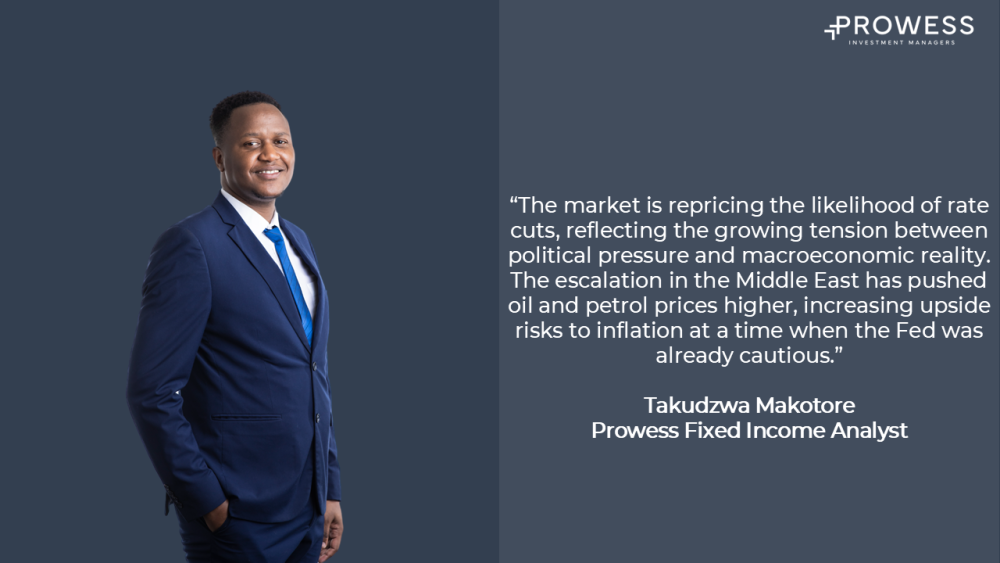
President Donald Trump has once again publicly pressured Jerome Powell to cut interest rates ahead of this week’s Federal Open Market Committee (FOMC) meeting, arguing that policy easing should be immediate. However, market pricing has moved in the opposite direction, with investors scaling back expectations for rate cuts in 2026. This repricing reflects a growing tension between political pressure and macroeconomic reality. The escalation in the Middle East has pushed oil and petrol prices higher, increasing upside risks to inflation at a time when the Fed was already cautious. Energy-driven inflation is particularly problematic because it can feed into broader price pressures, complicating the Fed’s path back to its 2% target.
Looking ahead, the US Fed is scheduled to meet on Wednesday and is widely expected to leave interest rates unchanged
Local Market Developments
Last week, local financial markets were not spared from the spillover in market instability emanating from the conflict in the Middle East. Last week, the JSE All-share was down 1.34% and down 10.5% since the US/Israel/Iran war broke out. The local bond market also saw risk-off sentiment from local and foreign investors. On average, the bond curve sold off 82 basis points across the curve. Most sell-off pressure was in the belly of the curve (selling-off by 90 basis points), primarily because a large share of foreign investor positioning is concentrated in this segment. With oil prices breaking above $100/bbl, concerns around fuel-driven inflation have intensified. As a result, traders have materially scaled back expectations for interest rate cuts by the MPC in 2026, reflecting a more cautious outlook for inflation and policy trajectory.
Looking ahead, inflation statistics for February are due for release on Wednesday.