

Abstract
In contemporary organisational discourse, the phrase “we are hiring” functions as a powerful symbol of growth, legitimacy, and success. Conversely, the equally consequential reality of workforce reduction, “we are firing”, is rarely articulated with comparable visibility or moral scrutiny, despite its profound human, social, and economic implications. This article interrogates the leadership ethics of organisational exit decisions, examining how retrenchment, termination, and layoffs are normalised within managerial rationality while their human consequences are marginalised. Drawing on leadership theory, stakeholder ethics, and responsible leadership frameworks, the article argues that ethical leadership extends beyond severance packages toward proactive stewardship of employee futures. Workforce reduction is reframed as a critical leadership moment that tests moral courage, institutional character, and long-term societal responsibility.
1. Introduction: The Asymmetry of Organisational Language
It has become customary for growing organisations to publicly announce “we are hiring.” This phrase carries symbolic power, signalling organisational vitality, strategic momentum, and economic success. Recruitment markets, executive search firms, and employer branding strategies are built around the positive connotations of workforce expansion.
By contrast, the equally material reality of workforce reduction, “we are firing”, is rarely articulated with comparable clarity. Instead, euphemisms such as retrenchment, downsizing, rightsizing, or mutual separation dominate organisational discourse. While linguistically palatable, these terms obscure the moral and human significance of employment termination (Gabriel, 2012).
This asymmetry reflects what Alvesson and Spicer (2016) describe as functional stupidity: a narrowing of ethical reflection in favour of instrumental rationality. Organisational entry is celebrated; organisational exit is sanitised. Growth is valorised, while disposability is normalised.
2. Normalisation of Workforce Reduction and Moral Desensitisation
Layoffs are routinely justified as rational responses to market volatility, technological disruption, mergers, automation, and shareholder pressure. Over time, repeated exposure to large-scale retrenchments has fostered moral desensitisation, particularly at senior leadership and board levels (Bauman, 2000).
The displacement of workers becomes abstracted into metrics—headcounts, cost savings, efficiency ratios—rather than recognised as lived human disruption. Yet empirical research consistently shows that job loss is associated with psychological distress, identity erosion, family instability, and long-term economic scarring (Jahoda, 1982; Blustein, 2019).
Leadership that frames layoffs purely as technical necessities risks what Heifetz, Grashow, and Linsky (2009) describe as technical reductionism: addressing adaptive, value-laden human problems with procedural fixes that avoid moral engagement.
3. Selection, Power, and Organisational Justice
Decisions regarding who remains and who exits are typically defended as pragmatic and merit-based, grounded in performance metrics, skills relevance, or future strategic alignment. However, organisational justice research demonstrates that employees evaluate retrenchment processes less by outcomes than by perceived fairness, transparency, and respect (Greenberg, 1990).
Accusations of executive self-preservation and distributive injustice frequently accompany layoffs, particularly when senior leaders remain insulated from sacrifice. Such perceptions have enduring consequences: erosion of trust, survivor guilt, disengagement, and reputational damage (Brockner, 1992).
Moreover, while some displaced employees transition successfully into new employment or entrepreneurship, others face structural constraints related to age, skills obsolescence, or labour market rigidity. Celebratory narratives of resilience often mask unequal access to opportunity (Standing, 2011).
4. Leadership Responsibility Beyond Severance
A central ethical question emerges: does organisational responsibility end with severance packages and legal compliance?
Traditional shareholder-centric models tend to answer affirmatively (Friedman, 1970). However, stakeholder theory challenges this narrow conception by asserting that organisations bear responsibilities toward all parties materially affected by their decisions, including employees whose livelihoods are terminated (Freeman, 1984).
Responsible leadership theory extends this argument further, framing leaders as moral agents embedded in social systems whose decisions generate consequences beyond organisational boundaries (Maak & Pless, 2006). From this perspective, involuntary separation constitutes not merely a contractual conclusion but a moral event.
5. Toward Future-Securing Leadership Practices
If leadership is fundamentally about stewardship, then workforce reduction demands future-oriented ethical responses. Several leadership practices emerge from the literature:
- Employability Stewardship Continuous investment in transferable skills enhances employee agency and labour market resilience, reducing the severity of displacement (De Vos, Van der Heijden, & Akkermans, 2020).
- Transition Support Ecosystems Career coaching, retraining programmes, job placement partnerships, and entrepreneurial incubation reflect relational responsibility rather than transactional disengagement (Blustein, 2019).
- Shared Sacrifice and Symbolic Leadership Kouzes and Posner (2017) emphasise that credibility is built when leaders “model the way.” Executive restraint during layoffs signals moral solidarity and strengthens institutional trust.
- Transparent Moral Framing Leaders who openly acknowledge the human cost of layoffs, rather than hiding behind euphemisms, demonstrate ethical courage and moral clarity (Brown & Treviño, 2006).
- Societal Partnership Models Cross-sector collaboration with governments, educational institutions, and civil society distributes responsibility for workforce transitions and aligns organisational actions with social sustainability (Senge et al., 2008).
6. “We Are Firing” as a Test of Leadership Character
Periods of retrenchment reveal organisational character more starkly than periods of growth. While “we are hiring” communicates expansion, “we are firing” exposes values, power relations, and ethical boundaries. Leadership scholarship consistently shows that trust is shaped less by success than by how leaders act under pressure (Dirks & Ferrin, 2002).
The issue, therefore, is not whether layoffs can be avoided in all circumstances, but whether leaders can manage exits without abandoning moral responsibility for those whose lives are disrupted.
7. Conclusion
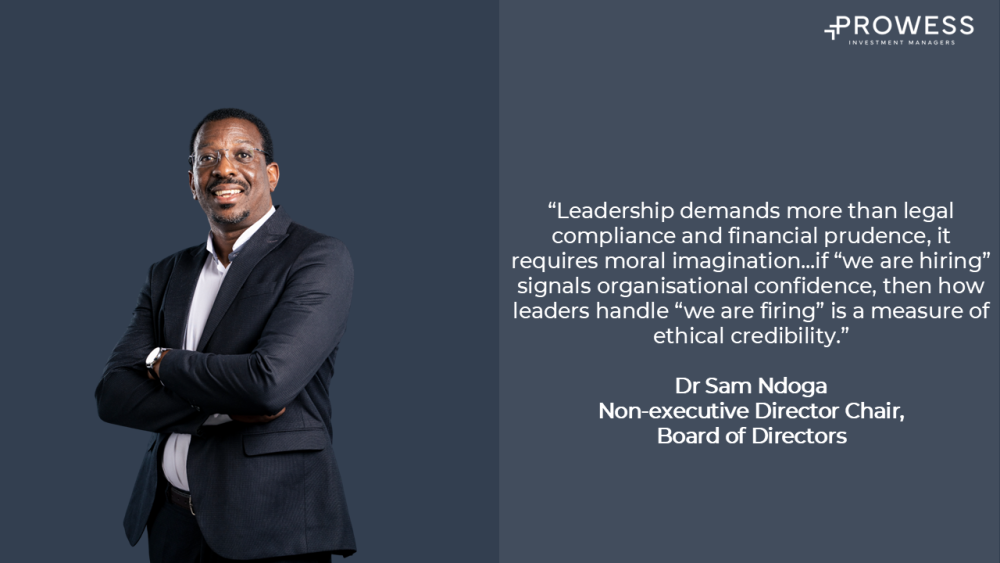
In an era of volatility and disruption, workforce reduction may remain an organisational reality. Yet leadership demands more than legal compliance and financial prudence. It requires moral imagination, the capacity to anticipate human consequences and design systems that preserve dignity even in departure.
If “we are hiring” signals organisational confidence, then how leaders handle “we are firing” is a measure of ethical credibility. The future of leadership lies not only in job creation, but in responsibly securing futures when jobs are lost.
References
Alvesson, M., & Spicer, A. (2016). The stupidity paradox: The power and pitfalls of functional stupidity at work. Profile Books.
Bauman, Z. (2000). Liquid modernity. Polity Press.
Blustein, D. L. (2019). The importance of work in an age of uncertainty. Oxford University Press.
Brockner, J. (1992). Managing the effects of layoffs on survivors. California Management Review, 34(2), 9–28.
Brown, M. E., & Treviño, L. K. (2006). Ethical leadership: A review and future directions. The Leadership Quarterly, 17(6), 595–616.
De Vos, A., Van der Heijden, B. I. J. M., & Akkermans, J. (2020). Sustainable careers: Towards a conceptual model. Journal of Vocational Behavior, 117, 103196.
Dirks, K. T., & Ferrin, D. L. (2002). Trust in leadership: Meta-analytic findings. Journal of Applied Psychology, 87(4), 611–628.
Freeman, R. E. (1984). Strategic management: A stakeholder approach. Pitman.
Friedman, M. (1970). The social responsibility of business is to increase its profits. The New York Times Magazine.
Gabriel, Y. (2012). Organizations in a state of darkness. Organization Studies, 33(9), 1137–1152.
Greenberg, J. (1990). Organizational justice: Yesterday, today, and tomorrow. Journal of Management, 16(2), 399–432.
Heifetz, R. A., Grashow, A., & Linsky, M. (2009). The practice of adaptive leadership. Harvard Business Press.
Jahoda, M. (1982). Employment and unemployment: A social-psychological analysis. Cambridge University Press.
Kouzes, J. M., & Posner, B. Z. (2017). The leadership challenge (6th ed.). Wiley.
Maak, T., & Pless, N. M. (2006). Responsible leadership in a stakeholder society. Journal of Business Ethics, 66(1), 99–115.
Senge, P., Smith, B., Kruschwitz, N., Laur, J., & Schley, S. (2008). The necessary revolution. Doubleday.
Standing, G. (2011). The precariat: The new dangerous class. Bloomsbury.