

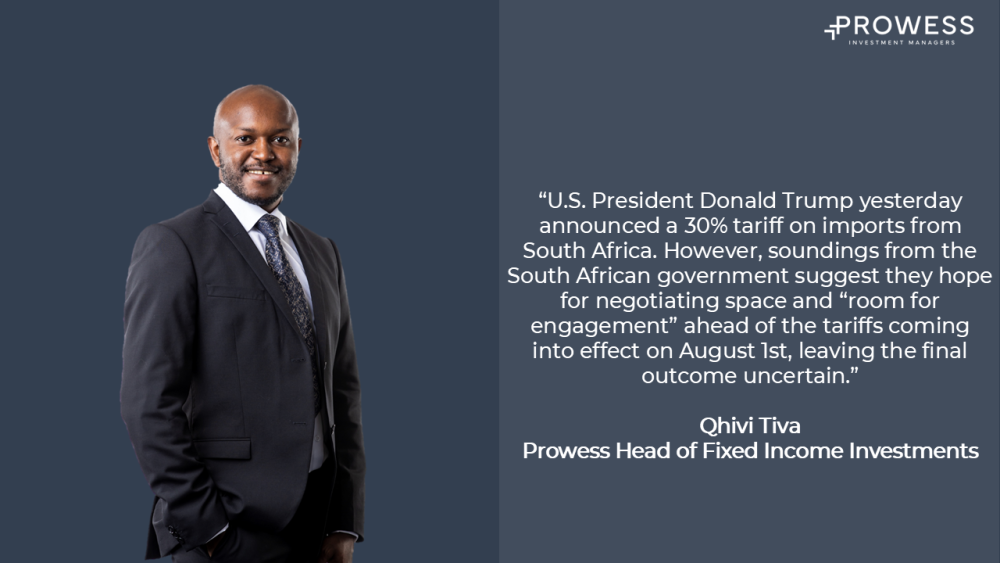
Federal Reserve Chair Jerome Powell emphasized a cautious approach to interest rate cuts due to new tariffs, which may increase inflation. US President Donald Trump announced on Monday 7 July that the US would subject imports from South Africa with a 30% tariff that would take effect from 1 August. However, there remains optimism about further negotiations with the US.
International Market Developments
U.S. President Donald Trump announced a 30% tariff on imports from South Africa, effective August 1, 2025. Additionally, he warned of a potential 10% tariff on countries aligning with BRICS’ “anti-American policies.” South Africa’s Trade and Industry Minister Parks Tau expressed optimism about ongoing trade discussions with the U.S., noting that recent talks suggested “room for engagement” beyond July 9, 2025.
Federal Reserve Chair Jerome Powell reiterated last week that the Fed’s rate-cutting trajectory has been tempered by the introduction of tariffs. Powell noted that the central bank is adopting a wait-and-see approach, as the effects of tariffs are expected to manifest in inflation data over the coming months. Consequently, the Fed is likely to make interest rate decisions on a meeting-by-meeting basis, with Powell not ruling out a potential rate cut later this month.
Atlanta Fed President Raphael Bostic echoed this cautious stance, highlighting that tariffs could exert persistent upward pressure on prices rather than a one-off spike. Fed policymakers remain divided, with some advocating for further rate cuts this year, while others, wary of sustained inflationary pressures, expecting rates to hold steady. Bostic also raised concerns about rising US government debt levels, which could “crowd out” other economic activities, impacting prices and employment.
Local Market Developments
Locally, South African Reserve Bank (SARB) Governor Lesetja Kganyago last week argued that the current 4.5% inflation target (mid-point of the 3-6% range) is undermining the rand and fuelling price increases, effectively doubling prices every 16 years. Kganyago advocated for a lower target of 3%, noting that South Africa’s inflation is high compared to global peers. A joint SARB and National Treasury team is reviewing the target and will present recommendations soon.
The Bureau for Economic Research (BER) reported a further deceleration in Q2:25 inflation expectations, with analysts, businesses, and trade unions projecting inflation below 4% for the current year—the first time in over four years. Expectations for 2026 and 2027 also eased to 4.3% and 4.5%, respectively, with longer-term expectations stabilising at 4.4%, below the SARB’s target mid-point.