


As the US election season kicks off, what lies ahead for financial markets?
2024 is due to be the biggest election year recorded with nearly half the world’s population hitting the voting booths.
The US election in November is arguably the one that will be watched the closest, as many countries are invested in the outcome due to the wide geopolitical influence and reach of the US.
Markets have experienced increased volatility following the South African, Mexican, Indian and, more recently, French election results, highlighting the often-underestimated impact of political risk.
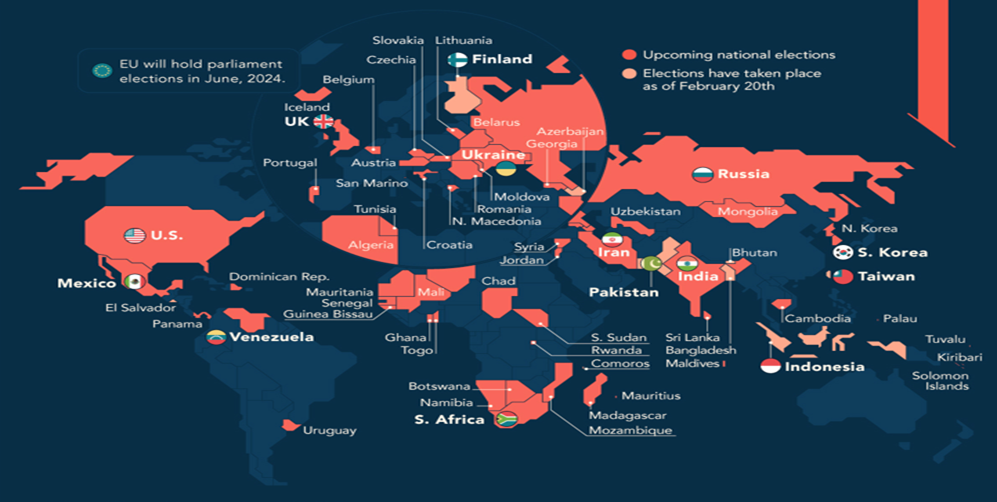
The election race between current president, Democrat Joe Biden, and Republican former president Donald Trump is widely expected to be closely contested according to current polls, with a handful of swing States expected to tilt the balance in the US Electoral College, which ultimately decides who wins a presidential election.
History of market movement during election cycles
The debate between the presidential candidates on 27 June marked the start of the election cycle, which then leads to their respective party’s formal party nomination conventions in July and August, before a scheduled second debate in September.
Events remain highly volatile and uncertain, and Saturday’s shocking assassination attempt against former President Trump is likely to have major, yet unclear, ramifications on the race. Even before that, and following the recent debate, polls were showing Donald Trump ahead of President Biden amongst likely voters, as the debate raised concerns in some quarters about Biden’s age and ability to govern effectively. These concerns have escalated within the Democratic Party, leading to division on whether Biden should remain as their candidate for the elections. A change of candidate will lead to uncertainty for the markets should Biden decide to withdraw.
The US bond market has started pricing in a Donald Trump victory, as reflected in a selloff in bonds yields on the anticipated tax-cuts and higher inflation that might accompany his Presidency. However, it is still early days, with the outcome of the election remaining uncertain and the winning margin likely to be tight either way.
As experienced with the recent general elections in South Africa, markets tend to be more volatile in the lead up to events such as general elections where political risks are heightened. Our domestic markets have since calmed as detailed information on the Government of Nation Unity and the new cabinet emerged, and focus has now shifted to assessing how effective the new administration will be at implementing the economic policy reforms that are needed in the economy.
Similarly, US markets, and by extension global markets, are likely to be more volatile as we get closer to the November election date amidst uncertainty around the future policy direction of the country.
However, several analyses of the performance of US markets during historical election periods indicate that election outcomes ultimately have a minimal impact on financial market performance in the medium to long term. This suggests that, even though markets tend to experience some volatility in the lead up to elections, market returns are ultimately far more dependent on economic fundamentals and inflation trends rather than election results.
What outcomes are markets looking out for?
Markets thrive in an environment of clarity and certainty that is conducive to the effective implementation of economic policy. The major policy items to monitor are those around the economy, spending priorities, immigration, healthcare, abortion, national security, and foreign policy (particularly in relation to China, Russia/Ukraine and Israel/Hamas).
In the US, the best scenario for policy execution is one where the winning party controls the White House and both houses of Congress. Currently, legislative power is split between the Democrats (Senate) and the Republicans (House of Representatives).
The election outcomes remain uncertain, as both parties will be looking to secure victory beyond just the White House.
What does the US election outcome mean for South Africa?
South Africa’s official foreign policy is one of ‘non-alignment’ between the US and nations such as Russia, Iran and China, who are often viewed as US adversaries. As diplomatic tensions have risen following the breakout of war in Ukraine and Gaza, this policy has come under increasing pressure. US Congress, mostly led by Republicans, have argued for a review of US-South Africa relations, arguing that South Africa’s foreign policy is detrimental to US national security and foreign policy interests. It is not yet clear how South Africa’s policy stance will shift, if at all, under the GNU.
The current Biden administration has been more conciliatory towards South Africa, and consequently it’s possible that a win for the Donald Trump at the November elections could pose a greater risk to South Africa’s economic relations with the US.